


Page 26 - Jacobello del Fiore - His Oeuvre and a Sumptuous Crucifixion
P. 26
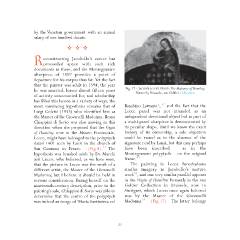
by the Venetian government with an annual             Fig. 17 - JACOBELLO DEL FIORE: The Madonna of Humility,
salary of one hundred ducats.                                 Formerly Brussels, van Gelder Collection

          eee                                         Bambino Lattante’; 52 and the fact that the
                                                      Lecce panel was not intended as an
Reconstructing Jacobello’s career has                 independent devotional object but as part of
     proceeded apace with such rich                   a multi-panel altarpiece is demonstrated by
documents as these, and the Montegranaro              its peculiar shape. Until we know the exact
altarpiece of 1407 provides a point of                history of its ownership, a sole objection
departure for his corpus thus far. Yet the fact       could be raised as to the absence of the
that the painter was adult in 1394, the year          signature read by Lanzi, but this may perhaps
he was married, leaves almost fifteen years           have been inscribed – as in the
of activity unaccounted for, and scholarship          Montegranaro polyptych – on the original
has filled this lacuna in a variety of ways; the      frame.53
most convincing hypothesis remains that of
Luigi Coletti (1953) who identified him as               The painting in Lecce foreshadows
the Master of the Giovanelli Madonna. Ileana          similar imagery in Jacobello’s mature
Chiappini di Sorio was also moving in this            work54, and one very similar parallel appears
direction when she proposed that the Virgin           in the Virgin of Humility formerly in the van
of Humility now in the Museo Provinciale,             Gelder Collection in Brussels, now in
Lecce, might have belonged to the polyptych           Stuttgart, which Lucco once again believed
dated 1401 seen by Lanzi in the church of             was by the Master of the Giovanelli
San Cassiano in Pesaro - ( Fig. 8).51 The             Madonna 55 - ( Fig. 17). The latter belongs
hypothesis was brushed aside by De Marchi
and Lucco, who believed, as we have seen,
that the picture in Lecce was the work of a
different artist, the Master of the Giovanelli
Madonna; but I believe it should be held in
serious consideration. Basing herself on the
nineteenth-century description, prior to the
painting’s sale, Chiappini di Sorio was able to
determine that the centre of the polyptych
was indeed an image of ‘Maria Santissima col

                                                  27

