
Allegory of Poetry(Eustache Le Sueur)
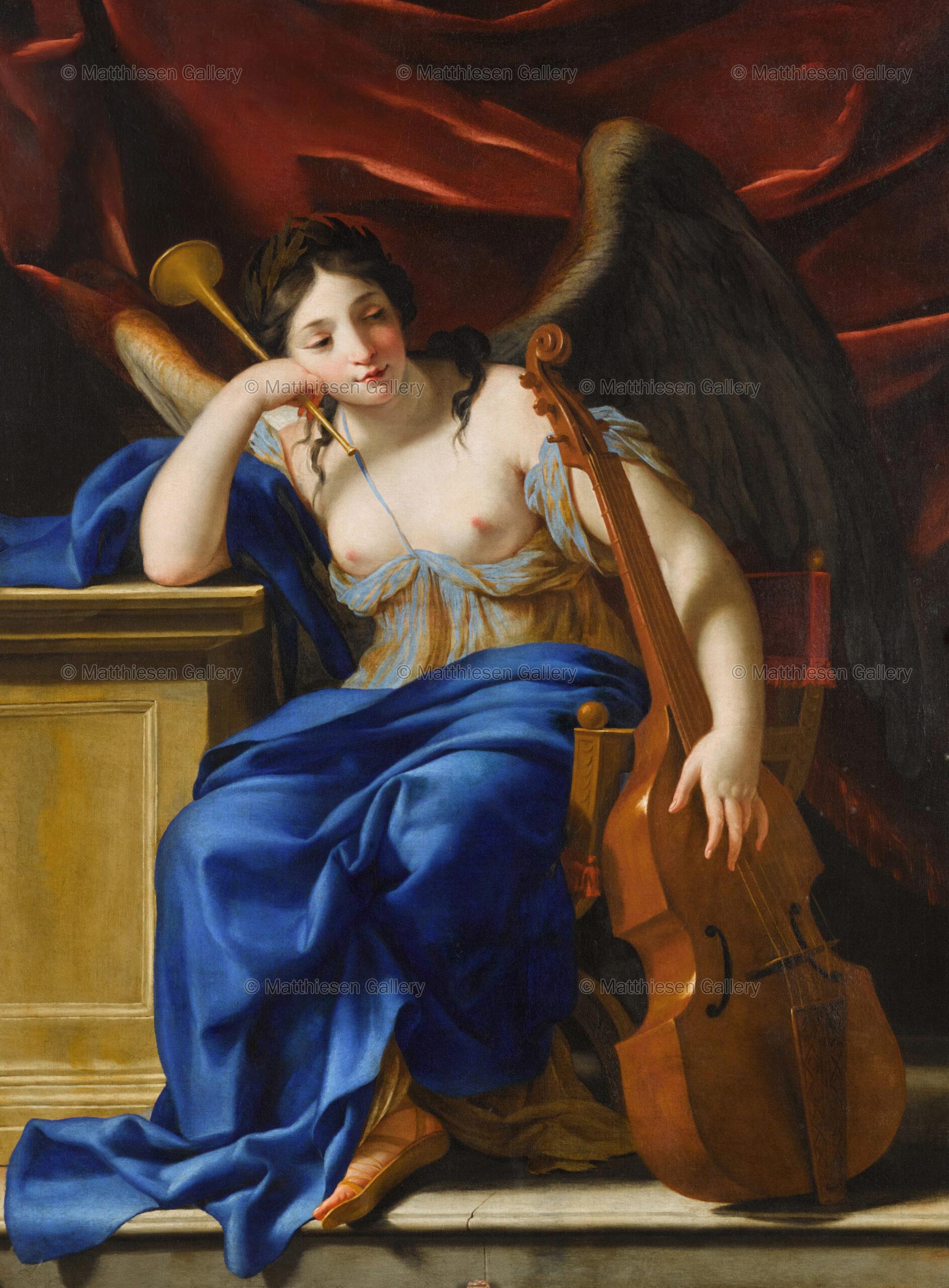
A striking masterpiece by the young Eustache Le Sueur, the Allegory of Poetry is an elegant composition displaying the influence of his master Simon Vouet (1590 –1649). Datable to the early 1640s when his career as an independent artist in Paris was flourishing, this work exhibits the development of his own accomplished style that would soon establish him as one of the most important painters of seventeenth-century France and a leading proponent of Parisian Atticism. Rediscovered in 2009, after having been in the same family collection for generations and unknown to scholars, the painting was found to have hung at the renowned Hôtel Lambert in the eighteenth century, and was likely commissioned directly from Le Sueur by the Lambert family to decorate their residence.
The Hôtel Lambert sits at the eastern tip of the Ile Saint-Louis on the River Seine in Paris. Built between 1640 and 1644, it was designed by the architect Louis Le Vau (1612 – 1670) for the financier Jean-Baptiste Lambert (1608–1644). After Lambert’s death in December 1644 – only about eight months after moving into the residence – his younger brother Nicolas Lambert de Thorigny (1613–1692) inherited the property and continued with its construction. It was Nicolas who commissioned most of the magnificent interior decoration, executed by the most famous French painters of the time, including Charles Le Brun (1619–1690), François Perrier (1590–1649) and Eustache Le Sueur, who in around 1646–47 executed a series of impressive canvases now in the Louvre, Paris (fig. 2). The subjects of their compositions explore themes relating to love and mythology, creating an innovative and coherent interior design that complemented the 17th-century architecture. After Nicolas’s death, the residence passed by descent in his family until 1732. After that, it belonged to various owners, including Émilie du Châtelet (1706 –1749), Voltaire’s mistress, who sold it in 1745 to Marin Delahaye (1684–1753). Upon Delahaye’s death in 1753, his brother Marc-Antoine Delahaye de Bazinville (1702–1785) inherited the property, and it is his direct descendants who in 2009 sold the Allegory of Poetry, having held it in the same family’s ownership for more than two and a half centuries.
The painting is first recorded in a document annexed to a deed of sale for the Hôtel Lambert dated 31 March 1739, where it is listed as an overdoor in the ‘Grand Cabinet’, a room that led to the ‘Cabinet de l’Amour’ in the state apartments. 1 While there are no records of the painting before this date, the earlier inventories of the Hôtel do not include the paintings that were inserted into elements of the décor, such as panelling, overdoors and ceilings, which likely accounts for its omission. The Allegory of Poetry is next recorded in an inventory dated 13 October 1753, where it is listed as Music in the form of a winged woman. This discrepancy is likely due to the presence of the trumpet and viola da gamba – the latter being a popular instrument in 17th-century France – although in fact the attributes of the figure in the present painting correspond directly with those of the allegorical figure of Poetry as described in Cesare Ripa’s Iconologia of 1593, an influential emblem book that inspired many artists of the day (fig. 3). Common to both is the laurel wreath, blue robe and bare breast, as well as the stringed instrument and trumpet.
The present work was not included in the posthumous sale of Marin Delahaye’s paintings held in 1754, nor in his widow’s sale of 1778 but was kept by his brother Marc-Antoine Delahaye de Bazinville. It was subsequently inherited by his daughter, Antoinette Marguerite Joseph Delahaye de Bazinville (1733–1813) who brought it first to the Hôtel Fieubet, near the Ile Saint-Louis but on the right bank, and then in 1813 to her château, near Paris, where it was rediscovered almost two centuries later. Although the painting was unknown to Alain Mérot when he published his 1987 catalogue raisonné on the artist, he has subsequently endorsed its attribution.
Stylistically this painting shows a number of similarities to The Triumph of Galatea, which sold in these Rooms in 2007.2 Datable to around to c. 1643, close comparison can be made between the female protagonists in each painting, particularly in the facial features which suggest they were both based on the same model (fig. 4). Somewhat unusually for a French artist of his stature, Le Sueur never left Paris for a tour of Italy but in 1632 was accepted into the studio of Vouet, who had returned from Rome in 1627. Le Sueur embraced the richness and sensuality of Vouet’s paintings, while also developing a classical elegance and harmony in his work. By the 1640s, Le Sueur was fully established as one of the city’s leading painters. In 1648 he was one of the twelve founding members of the Académie royale de peinture and he was appointed Peintre Ordinaire du Roi in 1649. His illustrious career was tragically cut short by his early death in 1655 at the age of just thirty-eight.
Probably commissioned directly from the artist by Jean- Baptiste Lambert (1608–1644), or his brother Nicolas Lambert de Thorigny (1613–1692), Hôtel Lambert, Paris;
Presumably by descent to the latter’s grandson, Alexandre- Louis Lambert de Thorigny, until 12 April 1732;
From whom likely acquired by Marie-Anne-Armande Carton Fontaine (1684–1745) and her son-in-law Claude Dupin (1686– 1769) and daughter Louise-Marie-Madeleine Fontaine (1706–1799), Hôtel Lambert, Paris, until 31 March 1739;
From whom acquired by Marquis Florent-Claude du Chastellet- Lomont (1695–1765) and his wife Gabrielle Émilie de Breteuil, Marquise du Châtelet (1706–1749), until 1745;
From whom acquired by Marin Delahaye (1684–1753), Hôtel Lambert, Paris, 1745–53;
Thence by inheritance to his brother, Marc-Antoine Delahaye de Bazinville (1702–1785), Hôtel Lambert, Paris;
Thence by descent to his daughter, Antoinette Marguerite Joseph Delahaye de Bazinville (1733–1813), Hôtel Fieubet, Paris;
Thence by descent until 2009;
By whom sold (‘From the Hôtel Lambert’), Paris, Christie’s, 23 June 2009, lot 88, for €1,353,000;
Where acquired by Noortman Master Paintings, Amsterdam;
By whom sold, New York, Sotheby’s, 28 January 2016, lot 37, for $970,000;
Private Collection, China, 2016;
Sotheby’s London, 3rd of July 2024;
Where acquired by the Matthiesen Gallery, London.
Inventory listing in deed of purchase of Hôtel Lambert, Paris, 31 March 1739, Archives nationales, Minutier central, LXXXVIII–565, in Boyer 2012, p. 151;
Inventory of paintings from the collection of the deceased Marin Delahaye, Paris, 13 October 1753, Archives nationales, Minutier central, LVII–408, no. 1378, in Bailey 2001, p. 70;
- Bailey, ‘Poussin’s L’enfance de Bacchus newly identified in two eighteenth-century collections’, in Mélanges en hommage à Pierre Rosenberg, Paris 2001, p. 70, appendix I, no. 1378;
- de Maintenant, ‘Redécouverte d’une œuvre de jeunesse d’Eustache Le Sueur provenant de l’hôtel Lambert’,
in L’Estampille – Objet d’Art, no. 447, June 2009, pp. 26–27, reproduced in colour p. 26;
Paris Tableau, Le salon international de la peinture ancienne,
exh. cat., Paris 2011, p. 14, reproduced in colour p. 14 (detail); J-C. Boyer, ‘Voltaire à l’hôtel Lambert, de Gomberville à Le Sueur’, in Revue Voltaire, no. 12, 2012, pp. 147–61, reproduced
- 148, fig. 1.
Maastricht, TEFAF, 12 March – 21 March 2010 and 18 March –
27 March 2011;
Paris, Palais de la Bourse, Paris Tableau, Le salon international de la peinture ancienne, 4–8 November 2011.
Maastricht, TEFAF, 12 March – 21 March 2026.