
The Adoration of the Magi(Ludovico Carracci)
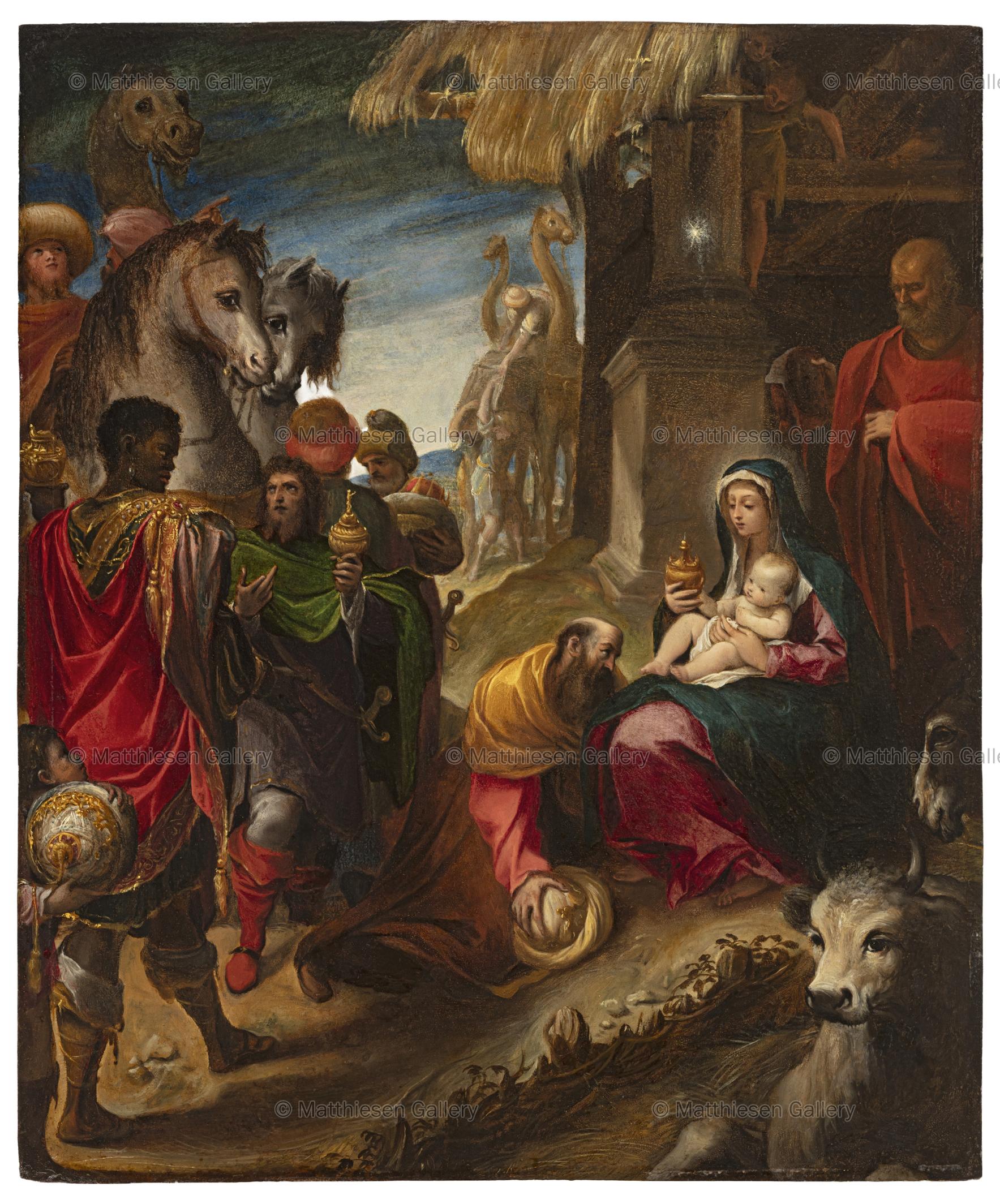
‘Ludovico trained with the mannerist painter Prospero Fontana before leaving for Venice, Parma and Florence to study the works of major north Italian artists. By 1578 he was back in Bologna where he became a member of the painter’s guild. With his cousins Agostino (1577-1602) and Annibale (1560-1609) he founded a teaching academy in 1582 in Bologna, which became the most celebrated of its kind and was responsible for the training of most major bolognese painters of the next generation, including Domenichino, Reni e Guercino. Whatever the individual roles played by each of the three Carracci, Ludovico as the oldest, seems to have been the primary manager of the academy, remaining its guiding light after the departure of his cousins for Rome.
His work is deeply impressed with the pietistic sentiment and didactic purposes of the counter- reformation. Based on the traditions of north Italian naturalism, particularly in the treatment of light and shade, Ludovico rejects the classical formulas of Florence and Rome, especially as these were repeated in the maniera statuina adopted by Bolognese painters of the generation of Vasari, and dispenses with elaborate perspectival constructions employed by Pellegrino Tibaldi to create an impression of directness, simplicity and naturalness of representation.
Correggio’s techniques were especially important to Ludovico’s art, for, by appealing to the simple and the natural sentiments of the viewer, he sought to identify those sentiments with a universal religious experience. The naturalness of Ludovico’s art is profoundly rhetorical and the experience he represents is intentionally devotional and exemplary’.[1]
***
Ludovico Carracci is a painter who never ceases to astonish with the unpredictability of the solutions he adopted from time to time, influenced by the destination and format of his works. He is generally considered to be less gifted and inventive than his younger cousin, Annibale (1560–1609), who, thanks to the works he executed in Rome, achieved a far greater renown. Remaining almost always in Bologna, Ludovico nonetheless pursued an artistic career marked by continual renewal, a momentum that only in his final years gave way to a certain weariness.
The most recognisable characteristic of his work was memorably defined in 1935 by Roberto Longhi as that of a ‘gruff professor of the cello [who] arches his melancholy and gigantic bowings’, alternating ‘the fleeting grace of Correggio, the muscular strength of Tibaldi, and Titianesque breadth’, so that ‘everything becomes sentimental life again, militant between heaven and earth, so close together’[2]. Anyone who is familiar with Bach’s Suites, performed in the years when Longhi was writing by the celebrated cellist, Pablo Casals (1876–1973), will readily grasp the meaning of Longhi’s magnificent metaphor, truly worthy of Stéphane Mallarmé. Indeed, the sound of the cello, like Ludovico’s painting, can alternate: the deepest, most harmonically rich notes – almost laden with dark forebodings – with others that are higher, silvery, and playful in effect.
This is precisely the case in the small painting here presented, executed on copper, a support that lends itself to luminous and brilliant effects. Ludovico employs a vivid chromatic range, in which various shades of red, green, violet, and yellow stand out. The composition is decidedly eccentric. The Madonna, holding the Child in her arms and with Saint Joseph behind her, sits crouched at the foot of a building of classical form which, over time, has fallen into ruin and, with the addition of a rustic thatched roof, has been transformed into a stable, from whose roof trusses several curious boys peer out.
Contrary to convention, the ox and the ass are not placed behind the Child to warm Him with their breath, but are positioned in the lower foreground, at the foot of the small hill upon which the Holy Family has settled; notably, the ox turns its large, gentle eyes out of the picture, towards the viewer. The elevated viewpoint allows the eye to follow the crevices and steep irregularities of the ground, upon which the other protagonists are arranged.
Melchior, the eldest of the Magi, sets his turban on the ground not only out of respect, but almost as if afraid of losing his balance; the vessel of gold he brings as a gift is already in the hands of the Madonna, who, with a dreamlike expression, shows it to the Child. Behind her stand Gaspar and Balthazar, engaged in conversation with one another. The former holds the thurible with incense, while the latter, traditionally depicted as an African man, carries in his left hand the small jar of myrrh, handed to him by one of his dignitaries mounted on one of the two horses that, together with a giraffe, lead the procession of the Magi.
In the background, behind the ruined building, further giraffes can be glimpsed, from the back of one of which two attendants are unloading a heavy trunk; closer to us, two dignitaries hold Gaspar’s turban. A small boy in the lower left struggles to hold in his arms Balthazar’s gold-woven headdress. Having guided the Magi on their journey from the East, the star has come to a halt and now stands motionless above the Child.
Such a result is not without Mannerist reminiscences. The ox’s astonished expression recalls ‘The Theft of the Oxen of the Sun’, frescoed by Pellegrino Tibaldi in one of the two Ulysses Rooms in Palazzo Poggi (1549–1551), while the preciosity of the jewelry, the elongation of the figures, and above all the distorted rendering of space – as if reflected in a convex mirror – point to Parmigianino.
This does not, however, mean that the painting must necessarily belong to Ludovico’s early phase. On the contrary, numerous clues suggest that it was executed during the years in which early writers placed his ‘flowering’, that is, the full attainment of artistic maturity.
‘Pur se restituiti attraverso un registro espressivo più aulico e monumentale, gli accorgimenti visivi esibiti in questo ramino sono infatti gli stessi che Ludovico adotta nei riquadri a lui spettanti nel ciclo con ‘Storie di Romolo’, affrescato insieme ai cugini intorno al 1590 per il neoeletto senatore Ludovico Magnani nel suo palazzo di Strada San Donato (l’odierna via Zamboni; il palazzo è attualmente sede di UniCredit Banca)[3].’
In a collective undertaking of this kind, it was essential that the three Carracci should strive to unify their styles as much as possible, in pursuit of a coherent result – so much so that Ludovico himself, whenever asked how the work had been divided and which panels belonged to whom, would habitually reply: ‘It is by the Carracci: we all made it.’[4] In this regard, noting precisely the coherence of the whole, Carlo Cesare Malvasia would later speak of a ‘peaceful, harmonious – indeed concerted – contrast’[5].
***
There is nevertheless no doubt that, even in this instance, Ludovico’s contribution stands out for a greater compositional exuberance, prompting him to exaggerate the gestures of the figures and to construct an uneven, precarious space, as if trapdoors and pitfalls were suddenly opening beneath their feet. In The Killing of Amulius (Fig. 1), the frame cuts violently through the soldiers in the foreground, as though they had fallen downwards, while one of the king’s dignitaries rolls across the floor, recalling a monstrous beetle which, overturned on its back, is unable to right itself. Colour, too, takes on acidic and anti-naturalistic tones, ranging from canary yellow to violet and bottle green. It thus becomes clear that for Ludovico, rather than the objective ‘truth’ sought by Annibale – one that would ultimately allow him, at the end of his career, to enter into harmony with Raphael and with antiquity – what truly matters is the ‘truth’ of emotions and feelings, which he regarded as no less concrete. ‘Grace’ and ‘terribilità’ were concepts that sixteenth-century culture had traditionally opposed – Correggio ‘against’ Michelangelo – but in Ludovico, by merging and integrating one with another, acquire an entirely new meaning, one that speaks directly to the sensibility of subsequent centuries. In effect, this is a grammar of ‘opposites’ placed at the service of a poetic artist which, by appealing to emotion, seeks to engage the viewer in the most direct and personal way.
In the small Adoration of the Magi, this grammar is employed in an even more playful—if not downright impertinent manner. How is it possible to treat with levity so noble a subject as the homage paid by the great ones of the earth to the Saviour of the world? And yet Ludovico succeeds, without in any way undermining the seriousness of the sentiments involved: the Virgin’s tenderness, the Child’s playfulness, the Magi’s concern to carry out their task in the best possible way. The small format readily lends itself to such an approach. Throughout his career, Ludovico alternated large altarpieces – destined by the spirit of the Counter-Reformation for the instruction of the illiterate – with small paintings aimed at private collectors, in which he could allow himself a less solemn, almost whimsical attitude.
At the two extremes of his career, we can mention, in this sense, The Marriage of the Virgin, formerly in the Palazzo Tanari in Bologna and now in the National Gallery in London[6] (Fig. 2), dated 1584-1585, and the Madonna and Child Enthroned with Saints in the Narodowe Muzeum in Warsaw, dated around 1616[7] (Fig. 6). Moving on to the years that interest us, the Madonna and Child Enthroned with Saints in the Hermitage Museum in St Petersburg[8] (Fig. 3) and the Adoration of the Shepherds in the Musée des Beaux-Arts in Dunkirk[9] (Fig.4) are characterised by an equally playful spirit. Even more striking is the comparison between the Adoration of the Magi discussed here and The Return of the Prodigal Son in the Staatsgemäldesammlungen in Munich[10] (Fig. 5), where characters with very similar connotations reappear.
It appears all the more striking, therefore, that the sources at our disposal make no mention of this copper painting by Ludovico Carracci. Indeed, no trace of it can be found in the long list of lost or dispersed works patiently compiled by Alessandro Brogi for his 2001[11] volume. Particular significance must therefore be attached to the mention of ‘a small painting of the Presentation of the Magi on copper with a gilded frame, a copy by Lodovico Carracci’, contained in the inventory drawn up on 12 September 1678 of the goods which, upon the death of Marco Antonio Mazzoni -resident in Bologna in Via de’ Gombruti, within the parish of San Barbaziano – passed to his nephews, Pietro Giacomo and Giovanni Francesco[12]. The fact that the painting was considered a copy might indicate that another version by Ludovico once existed, hitherto unrecorded by any other source; but it may also suggest that, confronted with an unusual work by Ludovico himself, the compiler of the inventory mistakenly judged it to be a copy, whereas it was in fact an autograph painting. At later dates, a ‘very small’ painting by Ludovico Carracci depicting The Adoration of the Magi appears in a sale held in London by John Strange (27 May 1799, lot no. 88)[13], while another painting representing The Adoration of the Magi, also painted on copper, was sold in London on 26 May 1806, paired with an Adoration of the Shepherds, likewise considered a work by Ludovico Carracci[14].
These references are, admittedly, inconclusive; yet they are not such as to diminish the importance of the rediscovery of this new copper painting, which fully qualifies as a small masterpiece by the great Bolognese artist.
- B.
[1] This biography was written by Gail Feigenbaum, a specialist on Ludovico Carracci for Matthiesen’s 1985 catalogued titled Around 1610.
[2] R. Longhi, Momenti della pittura bolognese, in “L’Archiginnasio”, XXX, 4, 1935, pp. 111-135; ried. in R. Longhi, Lavori in Valpadana (Edizione delle opere complete di Roberto Longhi, VI), Florence, Sansoni, 1973, pp. 189-205, in part. p. 200.
[3] Cfr. C. Volpe, Il fregio dei Carracci e i dipinti di Palazzo Magnani in Bologna, Bologna, Credito Romagnolo, 1972; A. Emiliani, Le storie di Romolo e Remo. Ludovico, Agostino e Annibale Carracci in Palazzo Magnani a Bologna, Bologna, Nuova Alfa, 1989; A. Brogi, Ludovico Carracci (1555-1619), Ozzano nell’Emilia (Bologna), Tipoarte, 2001, I, pp. 140-145, n. 32.
[4] C.C. Malvasia, Felsina pittrice. Vite de’ pittori bolognesi, Bologna, for the Heir of Domenico Barbieri, 1678, I, p. 392.
[5] Ibidem, I, p. 391.
[6] Inv. NG6595; oil on copper, 41,3 x 32,4 cm. Cfr. G. Feigenbaum, in Ludovico Carracci, exhibition catalogue Bologna, Pinacoteca Nazionale, 25 September – 12 December1993; Fort Worth, Kimbell Art Museum, 22 January – 10 April1994) edited by A. Emiliani, Bologna, Nuova Alfa, 1993, pp. 62–63, no. 29; A. BROGI, Ludovico Carracci cit., I, pp. 116–117, no. 12, with a proposed date of 1584–1585.
[7] Inv. 131076; oil on copper, 39,8 x 29,7 cm. Cfr. G. Feigenbaum, in Ludovico Carracci, exhibition catalogue (Bologna, Pinacoteca Nazionale, 25 September – 12 December1993; Fort Worth, Kimbell Art Museum, 22 January – 10 April1994) curated by A. Emiliani, Bologna, Nuova Alfa, 1993, pp. 62-63, n. 29; A. Brogi, Ludovico Carracci cit., I, pp. 116-117, n. 12, with a proposed date of 1584-1585. Finally, for this particular type of production, see also: A. Brogi, La ‘Notte’ di Ludovico Carracci, in “Prospettiva”, 167-168, 2017, pp. 148-155.
[8] Inv. 143; oil on copper, cm 43 x 22. Cfr. A. Brogi, Ludovico Carracci cit., I, pp. 137-138, n. 27.
[9] Oil on copper, 47 x 36 cm. Cfr. A. Brogi, Ludovico Carracci cit., I, p. 138, n. 28.
[10] The small painting (oil on copper, 43 x 36 cm) was returned to Ludovico Carracci by A. EMILIANI, Le storie di Romolo cit., p. 29, fig. cxx. Cfr. in addition, A. Brogi, Ludovico Carracci cit., I, p. 140, n. 31, who agrees that it dates from around 1590.
[11] A. Brogi, Ludovico Carracci cit., I, pp. 278-302.
[12] The inventory, drawn up by Reverend Annibale Gessi, parish priest of San Barbaziano and guardian and administrator of the assets assigned to the grandchildren, is attached to the deceased’s will. Bologna, State Archives, notary Arrighi Francesco (1654-1721), Minutario 1678-1679. Cfr. R. Morselli, Repertorio per lo studio del collezionismo bolognese del Seicento, Bologna, Patron, 1997, pp. 402-403, n. 590. For the full transcript: Getty Provenance Index, Archival Inventory I-1741, Page 4, Item 0023 (Mazzoni).
[13] Getty Provenance Index, Sale Catalog Br-A2428, Lot 0088. ‘A catalogue of the genuine, truly curious, and capital collection of original pictures by the most celebrated masters, of the Italian, Flemish, Dutch, French, and English schools from the earliest era of painting to the present time, collected at a vast expense, by the late John Strange, Esq. LL.D.F.R.&A.S. …: by order of the executors, the whole will be publicly exhibited and sold by private contract, at the European Museum, King St., St. James’s Square (Christie’s), on Monday, May 27, 1799, and following days’.
[14] Getty Provenance Index, Sale Catalog Br-414, Lot 1543.
Forbin collection since 1800.
Marseilles Art Gallery circa 1990.
Private Collector, Aix en Provence,
Matthiesen Gallery, London, 2025.