


Page 28 - Jordaens
P. 28
applied the vision of the large-scale figure painter to
                                                                               the popular culture of the Netherlands, first tapped as
                                                                               a fruitful source of subject matter by Pieter Brueghel

                                                                               the Elder in the previous century, and given further
                                                                               life by Adriaen Brouwer (1605-1638) and on occasion
                                                                               by Rubens himself.


                                                                                                    a


                                                                                        lthough Jordaens never received official
                                                                                        recognition from the Habsburg court in
                                                                               ABrussels, he was patronised by Protestant
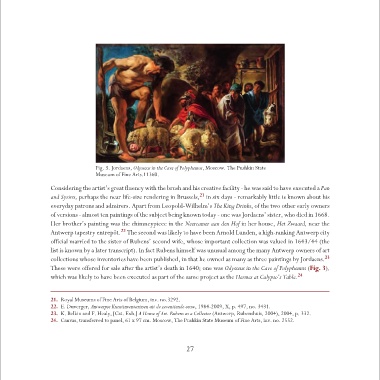
                                                                               rulers in Northern Europe. The commission, awarded                                                           Fig. 3. Jordaens, Odysseus in the Cave of Polyphemus, Moscow. The Pushkin State
                                                                                                                                                                                            Museum of Fine Arts.11360.
                     Fig. 2. Jordaens,Triumphof Prince Frederik Hendrik, Huis ten Bosch.   indirectly from King Charles I, to execute the cycle
                                                                               of the Story of Psyche to decorate Greenwich Palace in                                      Considering the artist’s great fluency with the brush and his creative facility - he was said to have executed a Pan
                                                                                                                                                                                                                                     21
                     1640-41, perhaps on the grounds that his charges would be less than those of Rubens, came to nothing because                                          and Syrinx, perhaps the near life-size rendering in Brussels,  in six days - remarkably little is known about his
                     of the death of the intermediary in Antwerp and then the political crisis in England. Jordaens, as far as is known,                                   everyday patrons and admirers. Apart from Leopold-Wilhelm’s The King Drinks, of the two other early owners
                                                                                             19
                     was only paid for the first of the twenty-two canvases in the planned cycle.  By the end of the decade, the artist’s                                  of versions - almost ten paintings of the subject being known today - one was Jordaens’ sister, who died in 1668.
                     renown had spread yet farther as he was to be approached by the King of Denmark and the Queen of Sweden.                                              Her brother’s painting was the chimneypiece in the Neercamer aan den Hof in her house, Het Zwaard, near the
                                                                                                                                                                                                      22
                     Of greater moment were the first contacts initiated towards the end of 1649 for the house of Orange that would                                        Antwerp tapestry entrepôt.  The second was likely to have been Arnold Lunden, a high-ranking Antwerp city
                     lead to the greatest challenge of his career, the design and execution of the Triumph of Prince Frederik Hendrik for                                  official married to the sister of Rubens’ second wife, whose important collection was valued in 1643/44 (the
                     the Oranjezaal in the Huis ten Bosch near The Hague (still in situ), which, over seven metres square, was installed                                   list is known by a later transcript). In fact Rubens himself was unusual among the many Antwerp owners of art
                                                                                                                                                                                                                                                                                       23
                     for the Dowager Princess of Orange in 1652 (Fig. 2). 20                                                                                               collections whose inventories have been published, in that he owned as many as three paintings by Jordaens.
                                                                                                                                                                           These were offered for sale after the artist’s death in 1640; one was Odysseus in the Cave of Polyphemus (Fig. 3),
                                                                                                                                                                           which was likely to have been executed as part of the same project as the Hermes at Calypso’s Table. 24
                     18.  Oil on canvas, 242 x 300 cm. Vienna, Kunsthistorisches Museum, inv. no. 786.
                     19.  See E. McGrath, Jordaens, Psyche and the Abbot. Myth, Decorum and Italian Manners in Seventeenth-Century Antwerp, 2009.
                     20.  We are well informed on this commission thanks to Jordaens’s correspondence with Constantijn Huygens. See M. Rooses,                             21.  Royal Museums of Fine Arts of Belgium, inv. no.3292.
                         Jordaens, 1906, pp. 255-258 (not included in M. Rooses, Jordaens, 1908) and, for instance, J. Vander Auwera et al. [Cat. Exh.],                   22.  E. Duverger, Antwerpse Kunstinventarissen uit de zeventiende eeuw, 1984-2009, X, p. 497, no. 3431.
                         Jordaens and the Antique (Brussels, Musées royaux des Beaux-Arts de Belgique / Kassel, Museumslandschaft Hessen Kassel,                           23.  K. Belkin and F. Healy, [Cat. Exh.] A House of Art. Rubens as a Collector (Antwerp, Rubenshuis, 2004), 2004, p. 332.
                         2012), 2012, p. 18.                                                                                                                               24.  Canvas, transferred to panel, 61 x 97 cm. Moscow, The Pushkin State Museum of Fine Arts, inv. no. 2552.


                                                                          26                                                                                                                                                    27

