


Page 29 - Jordaens
P. 29
s much if not more is known about the sale of tapestries designed by Jordaens during his lifetime than
the commerce in his paintings. The clientele would have been very different as the production of
Atapestry catered chiefly for the aristocracy, the extensive wall space of whose grand rooms required
decorative covering; the urban patriciate seemed to have concentrated more on the acquisition of paintings as
is borne out by the popular Antwerp genre of the kunstkamer or gallery interior, which rarely if ever depicted
tapestry. And while the aristocracy amassed both art forms, the rich bourgeoisie, on the whole, confined
themselves to pictures.
Of course there was a great tradition in the Southern Netherlands of weaving tapestries, and in Brussels
in particular where the tapestry industry was the largest employer, even after the religious persecutions
th
from about the middle of the 16 century. The emigration of Protestant weavers saw the establishment of
other centres of production, for instance in Paris and Delft and later Mortlake, but Brussels, during most of
Jordaens’ career, remained pre-eminent: witness the speedy weaving in c.1626 by four workshops of Rubens’
designs for the eight thousand square- metre Triumph of the Eucharist for the Governor of the Netherlands, the
Archduchess Isabella Clara Eugenia, as a present to the monastery of the Descalzas Reales in Madrid (and still
25
in situ). Jordaens would have been aware not only of the great tradition of tapestry production, but more
particularly of Rubens’ contribution to it when he was first approached to supply designs by a proprietor of a
tapestry workshop or a tapestry dealer such as Daniel Fourment, the father of Rubens’ second wife.
Our knowledge of the workings of the Brussels tapestry industry is hampered by the destruction of the
Brussels municipal archives by the French bombardment of the city in 1695. Furthermore, facts concerning
the interaction between the rich and powerful weavers of Brussels, with their particular craft tradition and
rules concerning the practice of weaving and the maintenance of standards of excellence, and the artists
commissioned to provide designs, seem not to have been the subject of any recent scholarly study, at least
insofar as this period is concerned. This is partly because by tradition the history of painting and drawing has
been treated separately from that of tapestry. Thus if the economics of the tapestry business itself remain to be
clarified, so does the attraction for artists in participating in it. Certainly if the example of earlier generations
of Flemish artists is taken into account, the rewards of collaboration in the weaving industry must have been
significant. How early that was a career consideration for Jordaens is a matter of speculation.
25. See N. De Poorter, ‘The Eucharist Series’ (Corpus Rubenianum Ludwig Burchard, II), I-II, 1978.
28 29
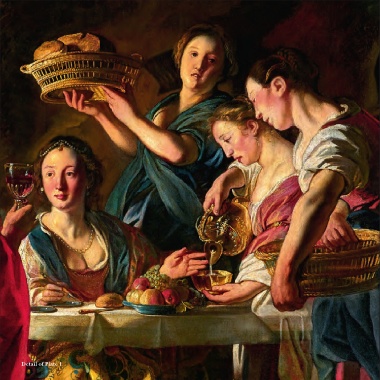
Detail of Plate 1

