


Page 71 - Jordaens
P. 71
The motif of the peasant with his bowl of porridge, his
                                                                         wife seated beside him with one arm outstretched dandling
                                                                         on her lap the child who wears a kerchief, remained for
                                                                                                                14
                                                                         a decade and a half dear to Jordaens . As the various
                                                                         renditions advance chronologically so the features of the
                                                                         satyr change subtly. His looks and age change, but so does
                                                                         his mien - he begins to laugh as he gestures towards the
                                                                         peasants. The addition of the satyr’s levity to Aesop’s fable

                                                                         appears unique to Jordaens. The motifs recur once again in
                                                                         a painting modified further c.1630-35 and set in an interior
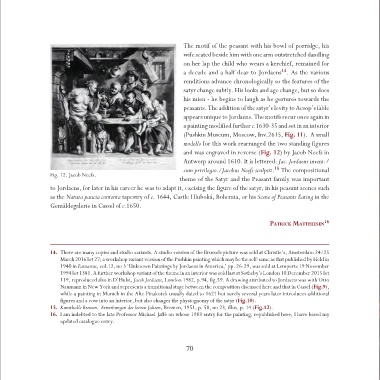
                                                                         (Pushkin Museum, Moscow, Inv.2615, Fig. 11).  A small
                                                                         modello for this work rearranged the two standing figures
                                                                         and was engraved in reverse (Fig. 12) by Jacob Neefs in
                                                                         Antwerp around 1610. It is lettered: Jac. Jordaens invent:/

                                                                                                             15
                                                                         cum privilegio./Jacobus Neefs sculpsit.  The compositional
                     Fig. 12. Jacob Neefs.
                                                                        theme of the Satyr and the Peasant family was important
                     to Jordaens, for later in his career he was to adapt it, excising the figure of the satyr, in his peasant scenes such
                     as the Natura paucia contenta tapestry of c. 1644, Castle Hluboká, Bohemia, or his Scene of Peasants Eating in the

                     Gemäldegalerie in Cassel of c.1650.


                                                                                                                                 16
                                                                                                           Patrick Matthiesen


                     14.  There are many copies and studio variants. A studio version of the Brussels picture was sold at Christie’s, Amsterdam 24/25
                         March 2016 lot 27; a workshop variant version of the Pushkin painting which may be the self-same as that published by Held in
                         1940 in Parnassus, vol.12, no 3 ‘Unknown Paintings by Jordaens in America,’ pp. 26-29, was sold at Lempertz 19 November
                         1994 lot 1381. A further workshop variant of the theme in an interior was sold last at Sotheby’s London 10 December 2015 lot
                         119, reproduced also in D’Hulst, Jacob Jordaens, London 1982, p.94, fig.59. A drawing attributed to Jordaens was with Otto
                         Naumann in New York and represents a transitional stage between the composition discussed here and that in Cassel (Fig.9),
                         while a painting in Munich in the Alte Pinakotek usually dated to 1621 but surely several years later introduces additional
                         figures and a cow into an interior, but also changes the physiognomy of the satyr (Fig.10).
                     15.  Kunsthalle Bremen.  Erwerbungen der letzen Jahren, Bremen, 1951, p. 58, no 23, illus. p. 14 (Fig.12).
                     16.  I am indebted to the late Professor Michael Jaffé on whose 1983 entry for the painting, republished here, I have based my
                         updated catalogue entry.


                                                                          70                                                                                                                                                    71


                                                                                                                                                                                                                                                                                    Detail of Plate 2

