


Page 17 - Joseph Wright of Derby: Virgils's Tomb & The Grand Tour.
P. 17
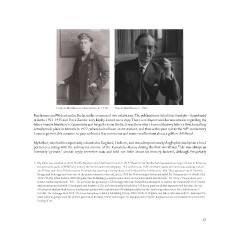
Francis Matthiesen Zatzenstein in 1918. Francis Matthiesen c. 1961.

Faschismus undWiderstand in Berlin on the occasion of two exhibitions.The publication is titled Gute Geschäfte – Kunsthandel
in Berlin 1933-1945 and Peter Zander very kindly loaned me a copy.There is a chapter and documentation regarding my
father Francis Matthiesen Zatzenstein and his galleries in Berlin. It was there that I learned that my father’s first Ausstellung
actually took place in Munich in 1922, where he had been an art student, and thus as this year marks the 90th anniversary
I cannot permit this occasion to pass without a few comments and some recollections about a golden childhood.

My father, who had been partially educated in England, I believe, and was always intensely Anglophile had spent a brief
period as a rating with the submarine service of the Kaiserliche Marine during the first world war.2 He was always an
intensely ‘private,’ almost coyly secretive man and told me little about his history. Indeed, although frequently

2. My father was attached to the U-Flotille Flandern which had been formed in 1915.These U-boat flotillas had represented as major a threat to Britain as
   the submarine packs ofWWII and, indeed, the former sunk more shipping – 4.5 million tons, 2554 merchant vessels and numerous warships, indeed
   one U-boat sunk three British cruisers in a single day. (see http://www.uboat.net/articles/index.html?article=48) .They operated out of Ostende,
   Brugge and Zebrugge and were one of the prime reasons for the raid, yet in 1918 the U-boats slipped away and sailed for Germany (see U-Flotille I & II
   1914-1918 by Johan Ryheul, 2002 (Regulus One Publishing) as well as www.uboat.net/articles/index.html?article=48 <http://www.uboat.net/
   articles/index.html?article=48> . He served at the great siege of Zeebrugge when the Royal Navy attempted to capture the canal and Port of Ostend
   with monitors armed with 12 inch guns and howitzers.The port was heavily defended by 120 heavy guns but British ingenuity and heroism, the use
   of Liverpool shallow draft ferries, a submarine packed with explosives and blockships resulted in the canal being obstructed. For a full story see P.
   Kendall, The Zeebrugge Raid 1918:‘The Finest Feat of Arms,’ History Publishing Group, 2009.While in Belgium, my father, who was only 21, was espied in
   naval uniform going round the picture galleries of Brussels, Ghent and Bruges. He was approached by the Belgians to join a commission to prevent the
   looting of art.

                                                                                                     17

