


Page 46 - Luca Giordano - Liberation of St Peter
P. 46
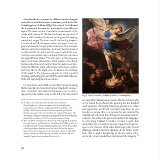
Giordano liked to contrast the different modes of angels               Fig. 9. LUCA GIORDANO, St.Michael, Berlin, Gemäldegalerie.
and soldiers, and this is where a similarity with the Berlin
Gemäldegalerie St Michael [Fig. 9] is evident. In St Michael             in a typically Raphaelesque manner.We do not know why
the demons and the saint are portrayed in two different                  or for whom he produced this painting but the finished
styles.The lower section depicts the brutal world of the                 work presents a heavenly, liberating presence in a dark
devils while above St. Michael is shown as a symbol of                   and oppressive world and Giordano may have set out
heaven with idealized features and a graceful swaying                    merely to convey this. In any case, he was inspired by
mantel and wings.The lower world, dark and grotesque,                    Raphael and reformed the old master’s monumental mas-
is rendered with Riberesque realism; the upper level, an-                terpiece. He unified the parts and updated the language.
gelic and classical, has pale pastel tonalities, blue and pink           In reforming Raphael Giordano created a work that
imbued with Reni’s classicism.Andreas Haus has focused                   would have been considered just as original as the proto-
on this conflict of modes and the way in which the con-                  type in the Vatican. With what Maria Loh calls ‘lateral
trast between animal nature and spirituality is expressed                thinking, which looked for shadows of the Father in the
through different styles.38 It is the same in The Liberation             Son,’ that is with a knowledge of the necessary refer-
where an intense chiaroscuro effect points to the divide                 ences, the viewer would have understood the imagery.39
between the divine and reality.These two spheres are pre-
sented in different styles, Riberesque in the lower section
and Reni-like in the angel. As in St Michael, the clothing
of the angel in The Liberation appears to carry a special
meaning, symbolizing the world of the spirit with elaborate
folds and especially luminous colour.

  De Dominici commented on Giordano’s memory saying
that he was able to remember by heart Raphael’s compos-
ition. Giordano internalised Renaissance art to such a
degree that the soldier seen on the left is foreshortened

38. A. Haus,‘Luca Giordanos hl. Michael in der Berliner
   Gemäldegalerie, Laokoonrezeption und die Künstlerische
   Konstruktion der Moral’, in Jahrbuch der Berliner Museen 140
   (1999) 77-89. Haus connects Giordano’s painting with Fritz
   Strich’s concept of the ‘antitetischen stil’ typical of Baroque.The
   dicothomy of this presentation is prefigured in the first St Michael
   painted by Giordano in 1657 for the Ascensione a Chiaia.

39. M. Loh, ‘New and Improved: Repetition and Originality in Italian
   Baroque Practice and Theory’, in Art Bulletin 86 (2004), p. 496. As
   Poussin had said: “Novelty in painting does not consist above all in
   choosing a subject that has never been seen before but upon a
   good and novel arrangement and expression, thanks to which the
   subject, though in itself ordinary and worn, becomes new and
   singular” (quoted and translated by Loh, ib.).

44

