


Page 264 - The mystery of faith
P. 264
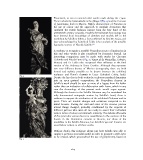
Francisco’s, as seen in several other works made during the 1740s.
                                           These include the Inmaculadas in San Miguel (Fig. 4) and the Convent
                                           of Justinianas, both in Murcia. Highly characteristic of Francisco is
                                           the use of colour and the approach to estofado decoration that
                                           emulated the textile fashions current from the first third of the
                                           seventeenth century onwards. Possibly the Italianate borrowings may
                                           have derived from knowledge of sketches and models left in the
                                           workshop by Salzillo’s father, a fact confirmed by Sánchez-Rojas, and
                                           later acknowledged by Isabella di Liddo in her analysis of the possible
                                           figurative sources of Nicolás Salzillo.10

                                           A tendency to recognize a possible Neapolitan source of inspiration in
                                           this and other works is also considered by Domenica Pasculi. An
                                           interesting comparison may be made with works by Giacomo
                                           Colombo and Nicola Fumo (Fig. 5; Virgen de la Maravillas, Cehegín,
                                           Murcia) and Di Liddo also recognized their influence in the final
                                           version of the Dolorosa in Santa Catalina. Although they represent
                                           two very different themes of Marian iconography, there are both
                                           formal and stylistic parallels to be drawn between the exhibited
Fig. 4 sculpture and Fumo’s Assunta in Lecce Cathedral (1689; Italy).
                                           Despite the fact that in both works the sculptors translated dynamism
                                           into an open gestural composition, the Neapolitan element in
                                           Salzillo’s work should be seen as more of a legacy from his father
                                           rather than an indication of collaboration with Fumo, which in any
                                           case the chronology of the present work would argue against.
                                           Although the boceto in the Salzillo Museum may be considered the
                                           only documented autograph version by Salzillo’s hand, there is
                                           evidence to support the attribution of the exhibited Dolorosa and its
                                           peers. There are notable changes and variations compared to the
                                           initial bocetos. During the trial and error of the creative process
                                           several things changed, probably conditioned by the requests of
                                           different patrons who were all too ready to assert their individual
                                           taste in terms of colour and dramatic intensity. The delicate silhouette
                                           of this particular version bears no resemblance to the contours of the
                                           boceto in the Dominican convent at Murcia, nor those of the
                                           modellino in the Salzillo Museum, but Salzillo’s ‘genetic’ features are
                                           nevertheless evident in all three works.

                                           Without doubt, this sculpture shows just how Salzillo was able to
                                           employ a previous successful model in order to promote a style, later
                                           to be revised, which personalized the use of polychromy, based on

Fig. 5

                                                                 264

