


Page 36 - Jordaens
P. 36
35
                                                                               (Fig. 7).  The visit to the Southern Netherlands
                                                                               of the cultivated prince (1595-1648), who became
                                                                               Wladislav IV Vasa when elected king in 1632,

                                                                               received great publicity; he was much honoured
                                                                               by the Archduchess Isabella, then Governor of the
                                                                               Netherlands, who commissioned Rubens to paint
                                                                                           36
                                                                               his portrait.  But this proposal too must remain
                                                                               hypothetical as no details about the commission are

                                                                               known. More fully documented is the legal dispute
                                                                               that arose following Geubels’s failure to deliver the
                                                                               tapestry set as promised in 1626. There is no record
                                                                               of the set’s existence in Poland and quite possibly it
                                                                               was never completed, let alone delivered.    Thus if
                                                                               Duverger’s proposal is put aside, it has to be admitted
                     Fig. 6. Jacob Geubels after Jordaens. Tapestry from the series   that like much of Jordaens’ early work, the identity
                     Scenes from Country Life.
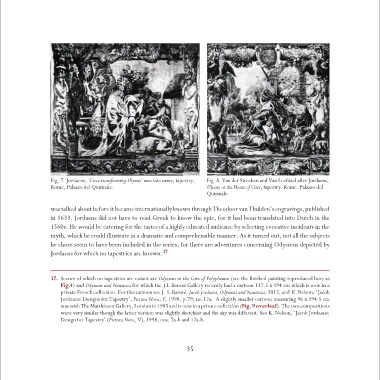
                                                                               of the patron of the Story of Odysseus - the dealer or                                      Fig. 7. Jordaens, ‘Circe transforming Ulysses’ men into swine, tapestry,   Fig. 8. Van der Strecken and Van Leefdael after Jordaens,
                     weaver who commissioned it - remains unknown; indeed only two sets are extant, one partial and woven by an                                            Rome, Palazzo del Quirinale.                                 Ulysses at the House of Circe, tapestry. Rome. Palazzo del
                     anonymous shop the other from the Van der Strecken and Van Leefdael looms and acquired by Carlo Emanuele                                                                                                           Quirinale.

                     (Fig. 8). We presume that the commission must have come sometime, perhaps through his growing reputation                                              was talked about before it became internationally known through Theodoor van Thulden’s engravings, published
                     and his claims as a waterschilder who had perhaps assisted Rubens c. 1625-27 in the preparation of the Decius Mus                                     in 1633. Jordaens did not have to read Greek to know the epic, for it had been translated into Dutch in the
                     tapestries. In this respect, too, is relevant the supposed policy of  the Archducal couple, Albert and Isabella,                                      1560s. He would be catering for the tastes of a highly educated audience by selecting evocative incidents in the
                     after the declaration of the Twelve Years Truce in the war against the United Provinces in 1609, to stimulate                                         myth, which he could illustrate in a dramatic and comprehensible manner. As it turned out, not all the subjects
                     the enterprise of the Brussels tapissiers in seeking out new tapestry designers.                                                                      he chose seem to have been included in the series, for there are adventures concerning Odysseus depicted by

                                                                                                                                                                           Jordaens for which no tapestries are known. 37
                     In fact the subject settled on for Jordaens was not novel, for it had been well rehearsed in tapestry before:
                     Homer’s Odyssey was the subject of a popular series woven in Brussels and designed by Michiel Coxcie (1499-
                     1592). Jan van der Straet, called Stradanus (1523-1605) designed another and, perhaps, the hugely ambitious                                           37.  Scenes of which no tapestries are extant are Odysseus in the Cave of Polyphemus (see the finished painting reproduced here as
                     and spectacular decoration at Fontainebleau of the long destroyed Galerie d’Ulysse by Primaticcio (1504-1570)                                            Fig.4) and Odysseus and Nausicaa for which the J.L Baroni Gallery recently had a cartoon 117.5 x 194 cm which is now in a
                                                                                                                                                                              private French collection. For this cartoon see J.-L.Baroni, Jacob Jordaens, Odysseus and Nausicaa, 2012, and  K.Nelson, ‘Jacob
                                                                                                                                                                              Jordaens: Designs for Tapestry’, Pictura Nova, V, 1998, p.79, no.12a.  A slightly smaller cartoon measuring 96 x 194.5 cm
                     35.  E Duverger, ‘Une Teinture de L’Histoire d’Ulysse livrée par Jacques Geubels le Jeune au Prince de Pologne’, Artes Textiles,                         was with The Matthiesen Gallery, London in 1985 and is now in a private collection (Fig. 9 overleaf). The two compositions
                         1971, VII, pp. 74 ff.                                                                                                                                were very similar though the latter version was slightly sketchier and the sky was different. See K. Nelson, ‘Jacob Jordaens:
                     36.  H.Vlieghe, Corpus Rubenianum Ludwig Burchard, XIX, Portraits, II, Antwerp Identified Sitters, 1987, pp. 123-124, no. 113.                           Design for Tapestry’ (Pictura Nova, V), 1998, nos. 7a-b and 12a-b.


                                                                          34                                                                                                                                                    35

