


Page 40 - Jordaens
P. 40
described in Homer’s epic. The hero had washed up alone on the Isle of Ogygia after his ship was wrecked in a
                     storm wrought by an implacably hostile Poseidon. Odysseus related how the ‘fair-tressed... guileful Calypso,
                     a dread goddess, and [with whom]... no one either of gods or mortals has anything to do’ had taken him to her

                     home and, he continued, ‘she said she would make me immortal and ageless all my days; but she could never
                     persuade the heart in my breast. There for seven years I remained continually, and always with my tears I kept
                     wet the immortal clothes which Calypso gave me’. At this point Zeus the Thunderer, at Pallas Athene’s behest,
                     intervened and commanded the divine messenger Hermes to tell Calypso that she must release Odysseus so
                     that he could return to his native land and his wife Penelope. Homer describes the scene Hermes found when

                     he reached Calypso’s domain: ‘...he came to a great cave, wherein dwelt the fair-tressed nymph... A great
                     fire was burning in the hearth, and far over the isle spread the fragrance of split cedar and citronwood, as they
                     burned… Round about the cave grew a luxuriant wood, alder and poplar and sweet smelling cypress, in which
                     long-winged birds made their nests …And right there above the hollow cave ran trailing a garden vine... There
                     even an immortal, who chanced to come, might gaze and marvel, and delight his soul’.


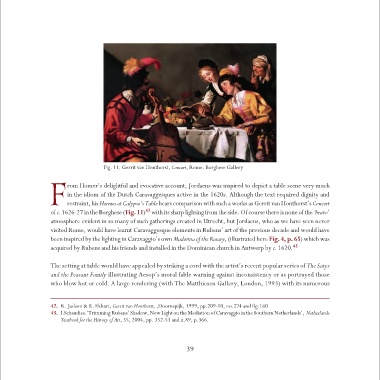
                     At the ensuing interview Calypso bewailed the envy of the gods ‘seeing that ye begrudge goddesses that they                                                               Fig. 11. Gerrit van Honthorst, Concert, Rome. Borghese Gallery
                     should mate with men openly, if any takes a mortal as her own bed-fellow’. The ‘great-hearted’ Odysseus was of
                     course absent ‘for he sat weeping on the shore, in his accustomed place, racking his heart with tears and groans                                            rom Homer’s delightful and evocative account, Jordaens was inspired to depict a table scene very much
                     and griefs…’ Jordaens, perhaps attracted by the description of the idyllic island and the flickering light in the                                           in the idiom of the Dutch Caravaggesques active in the 1620s. Although the text required dignity and

                     interior of the cave, depicted the moment described by Homer when the goddess set before Hermes ‘a table                                             Frestraint, his Hermes at Calypso’s Table bears comparison with such a works as Gerrit van Honthorst’s Concert
                                                                                                                                                                                                                42
                     laden with ambrosia [food of the gods] and mixed the red nectar. So he drank and ate...’                                                              of c. 1626-27 in the Borghese (Fig. 11)  with its sharp lighting from the side. Of course there is none of the ‘bravo’
                                                                                                                                                                           atmosphere evident in so many of such gatherings created in Utrecht, but Jordaens, who as we have seen never

                                                                                                                                                                           visited Rome, would have learnt Caravaggesque elements in Rubens’ art of the previous decade and would have
                                                                                                                                                                           been inspired by the lighting in Caravaggio’s own Madonna of the Rosary, (illustrated here Fig. 4, p. 65) which was
                                                                                                                                                                           acquired by Rubens and his friends and installed in the Dominican church in Antwerp by c. 1620. 43


                                                                        a                                                                                                  The setting at table would have appealed by striking a cord with the artist’s recent popular series of The Satyr
                                                                                                                                                                           and the Peasant Family illustrating Aesop’s moral fable warning against inconsistency or as portrayed those

                                                                                                                                                                           who blow hot or cold. A large rendering (with The Matthiesen Gallery, London, 1993) with its numerous


                                                                                                                                                                           42.  R. Judson & R. Ekkart, Gerrit van Honthorst, ,Doornspijk, 1999, pp.209-10, no.274 and fig.160
                                                                                                                                                                           43.  I.Schaudies.’Trimming Rubens’ Shadow, New Light on the Mediation of Caravaggio in the Southern Netherlands’,  Netherlands
                                                                                                                                                                              Yearbook for the History of Art, 55, 2004, pp. 352-53 and n.89, p.366.


                                                                          38                                                                                                                                                    39

