


Page 184 - The mystery of faith
P. 184
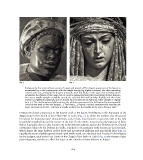
Fig. 1  Fig. 2

        Sculptures by this artist achieve a sense of repose and stasis [...] The elegant appearance of his figures is
        accentuated by a soft contrapposto with the weight-bearing leg slightly advanced, the other remaining
        relaxed and free [...] Usually, the drapery is smooth, with few folds, or only spare channel folds, which
        emphasizes the stillness of the image, but on occasion [appearing heavy] the faces [have] distinct features;
        the nose is usually straight or slightly curved, the eyes and their sockets bulge slightly, and often have
        lowered or slightly drooping lids, and are framed by accurately drawn eyebrows, either straight or slightly
        bent [...] The cheeks appear slightly sunken, the philtrum pronounced, the half-opened lips occasionally
        reveal carved teeth or even the tongue [...] The hands [...] display a realistic treatment that describes the
        bones and veins in detail [...] the hair is usually worked very thoroughly, in the proto-Baroque style.5

Perhaps the closest comparison to the present work is the figure of Balthazar, in the Adoration of the
Magi group in the Church of San Felipe Neri in Cadiz (Fig. 1), in which the sculptor also showcased
his talents for depicting racial characteristics, and, in fact, facial features in general, such as the full,
beautifully modelled lips and the texture of the hair. On the whole, however, the physiognomy of Saint
Benito is actually closer to that found in the artist’s Marian subjects, such as the Dolorosa in the Church
of Nuestra Señora de los Dolores in Seville, attached to the monastic order known as ‘Los Servitas’,
which shares the same knitted, arched brow and accentuated philtrum and naso-labial lines (Fig. 2).
Equally, the saint’s slightly opened mouth, with visible teeth, can also been seen in several Christ figures
by this sculptor, such as the Ecce Homo in the Chapel of San Pablo in Cadiz (Fig. 3); the Nuestro Padre
Jesús Nazareno; and the so-called ‘Sin Soga’ in the Church of Santa Bárbara in Ástigi.6

        184

