


Page 193 - The mystery of faith
P. 193
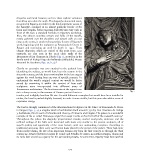
draperies and facial features, and it is these stylistic variations                                          Fig. 1
that allow us to date the work. The elegantly ornamental sense,
so typical of Bigarny, is evident in the thick serpentine waves of
the hairstyle, arranged in an almost guilloche border at the
brow and temples, before tapering delicately into tiny curls in
front of the ears: a standard formula in Bigarny’s workshop.
Also, the almost countless creases and folds of the mantle,
evenly gathered over the shoulders and pinned with an oval
clasp at the centre, is another characteristic feature of Bigarny’s
work, beginning with the sculptures at Peñaranda de Duero in
Burgos and continuing up until his death in 1542. These
elegant draperies, which are typical of this artist from 1536
onwards, are also seen in the 1536 choir stalls of the
Monastery of San Clemente in Toledo (Fig. 1), as well as in the
family tomb of Bishop Diego de Avellaneda (Valladolid, Museo
Nacional de Escultura; Figs. 2a, b, c).2

Clearly no cartouche was ever attached to the pedestal base
identifying the subject, as would have been the custom in the
sixteenth century, and the deep emotionalism in the face argues
against the work having been any sort of specific portrait. To
understand the work’s original context we would be better
served by examining it within the context of how such
sculptures were incorporated into different areas of
Renaissance architecture. The bust truncates at the upper torso
into a sharp curve, in the manner of Roman portrait busts or
tondos, and is slightly less than life size. As with Italianate examples that would have been installed in
niches, the head is pushed slightly forward, to make it more visible, but this pose also adds a sense of
expressive energy.

The bust is strongly reminiscent of the aforementioned sculptures in the Palace of Peñaranda de Duero
in Burgos (Figs. 3, 4), a singular work of architecture built around 1530 by Don Francisco de Zúñiga
y Avellaneda, third Count of Miranda and Viceroy of Navarre and Naples. The palace is a wonderful
example of the so-called Plateresque style3 that swept Castile in the first half of the sixteenth century.4
Throughout the palace the elegantly proportioned arcades, storied courtyards, staircases and the
coffered ceilings of the halls were decorated with busts very similar to the present sculpture, all of
superb quality and apparently of the same facture, with one outstanding exception. According to
traditional accounts, there were two Roman busts placed in the portal of the palace. These had come
from nearby Clunia, the site of an important Roman city from the first century BC through the third
century AD. Situated between Coruña de Conde and Peñalba de Castro, in southern Burgos, Clunia and
its ruins later served as a quarry for the surrounding towns. At some time, Bigarny must have worked

193

