


Page 196 - The mystery of faith
P. 196
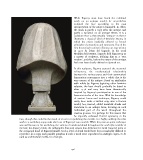
While Bigarny must have based the exhibited
                                                                     work on an antique model, he nevertheless
                                                                     sculpted the face according to his own
                                                                     interpretation of the subject demanded. In effect,
                                                                     the work is partly a copy after the antique and
                                                                     partly a variation on an antique theme. It is a
                                                                     sculpture that is theoretically ‘antique’ in that it
                                                                     illustrates a classical ideal of feminine beauty, in
                                                                     which the artists implicitly adhered to formal
                                                                     principles of proportion and symmetry. One of the
                                                                     first theoretical treatises in Roman art was written
                                                                     in 1526 by Diego del Sagrado. In his work
                                                                     Medidas del Romano, Sagrado held Bigarny up as
                                                                     a master of sculpture, defining him as a ‘true
                                                                     modern’, and this, before the nature of the antique
                                                                     had even been clearly defined in Spanish art.

                                                                     In this sculpture, Bigarny captured the measured
                                                                     refinement, the mathematical relationship
                                                                     between the various parts and their symmetrical
                                                                     harmonious convergence into a whole that is the
                                                                     very essence of the antique. Based on similarities
                                                                     with reliefs by Bigarny depicting other feminine
                                                                     subjects, the bust should probably be dated to
                                                                     after 1536 and may have been thematically
                                                                     inspired by Bigarny’s participation in one of the
                                                                     humanist circles of the time. With his knowledge
                                                                     of ancient forms and technique, Bigarny could
                                                                     easily have made a faithful copy after a Roman
                                                                     model, but, instead, added manifold details and
                                                                     variations to an antique form, focusing on each
                                                                     individual part of the work throughout the
                                                                     creative process. It is perhaps for this reason that
                                                                     he arguably eschewed frontal symmetry in the
face, though this could be the result of an error in polishing the marble. It is highly unlikely that this
work is a workshop copy made after one of Bigarny’s own models. While the point-to-point technique
was well known in his workshop, the variety of incidental detail throughout the work (the tendrils of
the hair, the drapery folds, the calligraphic lines and volutes that delineate the facial features) point to
the autograph hand of Bigarny himself. Such a level of detail would have been remarkably difficult to
reproduce in a copy, and possibly pointless if such a work were reproduced in multiple copies, to be
used as architectural motifs, for example.

                                                                 196

