


Page 204 - The mystery of faith
P. 204
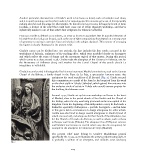
Another particular characteristic of Giralte’s work is his focus on detail, such as hairstyles and shoes,
          and it is worth pointing out that this fondness for capturing specific minutiae grew out of his repeatedly
          making sketches and drawings for silversmiths. To this decorative precocity belongs the beard of Saint
          Joachim, a feature of the relief that could have come out of Felipe Bigarny’s workshop, and that is
          stylistically similar to one of that artist’s first sculptures for Palencia Cathedral.

          Francisco Giralte is defined as an eclectic, an artist so driven to assimilate that he poached elements of
          his style from his rival, Juan de Juni, such as the use of tight compositions that depend on a strong sense
          of symmetry to maintain narrative focus and clarity in the subject depicted. This manner of arranging
          the figures is clearly illustrated in the present relief.

          Giralte’s career can be divided into two periods, the first includes his first works executed in the
          workshops of Palencia, sculptures of far-reaching effect, which were modelled closely on Berruguete
          and which reflect the sense of drama and the movement typical of that master. During this period,
          which comes to a close around 1548, Giralte made the altarpiece of the Cisneros in Palencia, one for
          the Monastery of Valbuena (lost), and another for the Corral Chapel of the parish church La
          Magdalena in Valladolid.

          Giralte’s second period is distinguished by his most important Madrid commissions, such as the famous
          Chapel of the Bishop, a family chapel in the Plaza de La Paja, a spectacular funerary space that

                                                    anticipates the royal sepulchres of El Escorial (Fig. 5). Giralte secured
                                                    this commission as a result of the fame he had acquired from his work
                                                    on the choir stalls in Toledo Cathedral, which gained him entrance into
                                                    the exclusive circle of artists in Toledo who would oversee projects for
                                                    the budding Madrilenian court.

                                                    Around 1550, Giralte set up his new workshop and home in the heart
                                                    of Madrid, close to the parish church of San Andrés and the Chapel of
                                                    the bishop, when the city was being promoted as the new capital of the
                                                    kingdom. From the beginning of his independent career, he had made a
                                                    distinctive speciality of altarpieces – just like Berruguete – and his fame
                                                    in this genre led to commissions to design altarpieces for other artists.
                                                    Giralte was also hired to design several altarpieces in Madrid (most of
                                                    which are now lost), including one for the Church of the Almudena, two
                                                    for the Church of Pozuelo de Alarcon, as well as others, such as those
                                                    in Barajas and Ocaña (Toledo). The altarpiece from El Espinar survives
                                                    and Giralte’s intervention in several others may also be recognized, for
                                                    example in the altarpiece in Colmenar de Oreja (Madrid).

                                                    The present relief must belong to Giralte’s Madrilenian period,
                                                    specifically the 1550s, as it illustrates the artist’s predominating style. It
                                                    is probably a section of an altarpiece, and includes some necessary

Fig. 3

                                                                            204

