Page 42 - Jordaens
P. 42

44
                                                                                                                                                                           pentimenti shows him developing his ideas c. 1616-18,  which culminated in a group of masterpieces, of
                                                                                                                                                                           which one at Cassel has been dated c. 1623-25. A starting point for Jordaens may have been a print by Marcus
                                                                                                                                                                                                              45
                                                                                                                                                                           Gheeraerts the Elder (1557-1629).  But he was to reject the high viewpoint and although he first conceived
                                                                                                                                                                           the scene as an upright in which the ceiling of a barn is depicted, he preferred the challenge of describing it
                                                                                                                                                                           from below and close- up in such a way that the legs of the furniture and the protagonists require disentangling.
                                                                                                                                                                           He chose bright, slanting lighting with shadows and rearranged the protagonists in the varying versions so as
                                                                                                                                                                           to find different ways to express the effect of the
                                                                                                                                                                           words of the truth-speaking satyr. About twenty

                                                                                                                                                                           years later the artist’s interest in the potential of
                                                                                                                                                                           gatherings at table was revived in his renderings
                                                                                                                                                                           of the The King Drinks and As the old sing, so the
                                                                                                                                                                           young pipe, the hilarious scenes of family life for
                                                                                                                                                                           which Jordaens is famous.


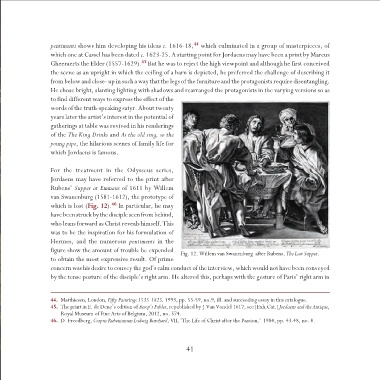
                                                                                                                                                                           For the treatment in the Odysseus series,
                                                                                                                                                                           Jordaens may have referred to the print after
                                                                                                                                                                           Rubens’ Supper at Emmaus of 1611 by Willem
                                                                                                                                                                           van Swanenburg (1581-1612), the prototype of
                                                                                                                                                                                                   46
                                                                                                                                                                           which is lost (Fig. 12).  In particular, he may
                                                                                                                                                                           have been struck by the disciple seen from behind,
                                                                                                                                                                           who leans forward as Christ reveals himself. This
                                                                                                                                                                           was to be the inspiration for his formulation of
                                                                                                                                                                           Hermes, and the numerous  pentimenti in the
                                                                                                                                                                           figure show the amount of trouble he expended      Fig. 12. Willem van Swanenburg  after Rubens, The Last Supper.

                                                                                                                                                                           to obtain the most expressive result. Of prime
                                                                                                                                                                           concern was his desire to convey the god’s calm conduct of the interview, which would not have been conveyed
                                                                                                                                                                           by the tense posture of the disciple’s right arm. He altered this, perhaps with the gesture of Paris’ right arm in


                                                                                                                                                                           44.  Matthiesen, London, Fifty Paintings 1535-1825, 1993, pp. 55-59, no.9, ill. and succeeding essay in this catalogue.
                                                                                                                                                                           45.  The print in E. de Dene’s edition of Aesop’s Fables, republished by J.Van Vondel 1617, see [Exh.Cat.] Jordaens and the Antique,
                                                                                                                                                                              Royal Museum of Fine Arts of Belgium, 2012, no. 574.
                                                                                                                                                                           46.  D. Freedberg, Corpus Rubenianum Ludwig Burchard, VII, ‘The Life of Christ after the Passion,’  1984, pp. 43-48, no. 8.


                                                                          40                                                                                                                                                    41


          Detail of Plate 1
   37   38   39   40   41   42   43   44   45   46   47