


Page 45 - Jordaens
P. 45
here for conscious borrowing in emulation is unnecessary as the pose nearly repeats that used for the maid in                                             n the widening scope of pictorial representation in Antwerp at the time when Jordaens was embarking on
                     Jordaens’ earlier portrayal of himself with his parents and siblings in the Hermitage (Fig. 16 overleaf). 53                                              his career, still-life and animal specialists began to come to the fore. It remains debateable as to whether
                                                                                                                                                                          Ihe ever turned to still-life specialists for the fruit and flowers that were to enhance his renderings of

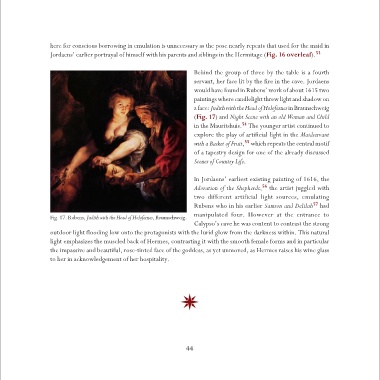
                                                                              Behind the group of three by the table is a fourth                                           abundance and fertility, but his protean genius embraced the depictions of animals early on, and the alert goat
                                                                              servant, her face lit by the fire in the cave. Jordaens                                      standing in the entrance to the cave must be one of the artist’s earliest treatments of what was to become a
                                                                              would have found in Rubens’ work of about 1615 two                                           favourite creature. Above, a parrot and peacock are also harbingers of Jordaens’ well-observed menagerie.
                                                                              paintings where candlelight threw light and shadow on                                        In the treatment of the bread and fruit brought to the feast, Jordaens shows himself to have mastered the
                                                                              a face: Judith with the Head of Holofernes in Braunschweig                                   still-life idiom established by the great Frans Snyders (1579-1657).

                                                                              (Fig. 17) and Night Scene with an old Woman and Child
                                                                                                54
                                                                              in the Mauritshuis.  The younger artist continued to                                         For the alert viewer the two exotic birds might have added associations that provided further accents to
                                                                              explore the play of artificial light in the Maidservant                                      Homer’s story. In the parrot could be read references to both the eloquence of Hermes and maybe the
                                                                                                 55
                                                                                                                                                                                                      58
                                                                              with a Basket of Fruit,  which repeats the central motif                                     love harboured by Calypso , while in the peacock would have been seen the emblem of the goddess Hera,
                                                                              of a tapestry design for one of the already discussed                                        protectress of marriage.
                                                                              Scenes of Country Life.


                                                                              In Jordaens’ earliest existing painting of 1616, the                                                                                           a
                                                                                                        56
                                                                              Adoration of the Shepherds,  the artist juggled with
                                                                              two different artificial light sources, emulating
                                                                                                                            57
                                                                              Rubens who in his earlier Samson and Delilah  had
                                                                              manipulated four. However at the entrance to                                                           ermes at Calypso’s Table by Jordaens of c. 1625-35 has only recently come to light and thus has not been
                     Fig. 17. Rubens, Judith with the Head of Holofernes, Braunschweig.
                                                                              Calypso’s cave he was content to contrast the strong                                                   discussed in studies on the artist. It is at once mysterious in atmosphere and imbued with a sense of
                     outdoor light flooding low onto the protagonists with the lurid glow from the darkness within. This natural                                          H potential drama, a striking addition to those works Jordaens executed both to accompany and be part
                     light emphasizes the muscled back of Hermes, contrasting it with the smooth female forms and in particular                                            of his preparations for one of his earliest essays in the tapestry business. In this case, it takes the composition
                     the impassive and beautiful, rose-tinted face of the goddess, as yet unmoved, as Hermes raises his wine glass

                     to her in acknowledgement of her hospitality.

                                                                                                                                                                           53. Oil on canvas ,175 x 137.5 cm, State  Hermitage Museum, inv. no. GE 484, see N. Gritsay and N. Babina, State  Hermitage
                                                                                                                                                                              Museum Catalogues Seventeenth and Eighteenth Century Flemish Painting, New Haven/London, pp. 147-149.
                                                                                                                                                                           54.  Oil on panel 79 x 64 cm, kept by Rubens for his own collection, offered by Sotheby’s, London, 7 July 2004, lot 30.
                                                                                                                                                                           55.  Oil on canvas, 119.6 x 157 cm, Glasgow, Kelvingrove Art Gallery and Museum, inv. no. 84.
                                                                        a                                                                                                  56.  Oil on canvas, transferred from wood, 106.7 x 76.2 cm. New York, The Metropolitan Museum of Art, inv. no. 67.187.76.

                                                                                                                                                                                                                                           .
                                                                                                                                                                           57.  Oil on panel, 185 x 205 cm. London, National Gallery, inv. no. 6461.

                                                                                                                                                                           58. See the commentary on the French School, c. 1530, Portrait of a Lady with a Parrot in the Walker Art Gallery, Liverpool, in
                                                                                                                                                                              Walker Art Gallery, Foreign Catalogue, Mersey County Council,1972,I,pp.76-77.


                                                                          44                                                                                                                                                    45

