


Page 48 - Jordaens
P. 48
a step further, following his execution
of an oil sketch that was last recorded in
the Reimann collection in Stensbygaard
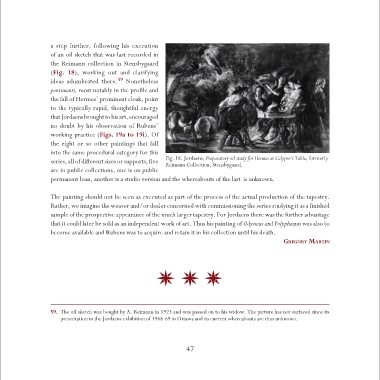
(Fig. 18), working out and clarifying
59
ideas adumbrated there. Nonetheless
pentimenti, most notably in the profile and
the fall of Hermes’ prominent cloak, point
to the typically rapid, thoughtful energy
that Jordaens brought to his art, encouraged
no doubt by his observation of Rubens’
working practice (Figs. 19a to 19i). Of
Fig. 19a. Fig. 19b. Fig. 19c. the eight or so other paintings that fall
into the same procedural category for this
series, all of different sizes or supports, five Fig. 18. Jordaens, Preparatory oil study for Hermes at Calypso’s Table, formerly
Reimann Collection, Stensbygaard.
are in public collections, one is on public
permanent loan, another is a studio version and the whereabouts of the last is unknown.
The painting should not be seen as executed as part of the process of the actual production of the tapestry.
Rather, we imagine the weaver and/or dealer concerned with commissioning the series studying it as a finished
sample of the prospective appearance of the much larger tapestry. For Jordaens there was the further advantage
that it could later be sold as an independent work of art. Thus his painting of Odysseus and Polyphemus was also to
become available and Rubens was to acquire and retain it in his collection until his death.
GreGory Martin
a a a
Fig. 19d. Fig. 19e. Fig. 19f.
59. The oil sketch was bought by A. Reimann in 1923 and was passed on to his widow. The picture has not surfaced since its
presentation in the Jordaens exhibition of 1968-69 in Ottawa and its current whereabouts are thus unknown.
46 47
Fig. 19g. Fig. 19h. Fig. 19i.

