


Page 49 - Jordaens
P. 49
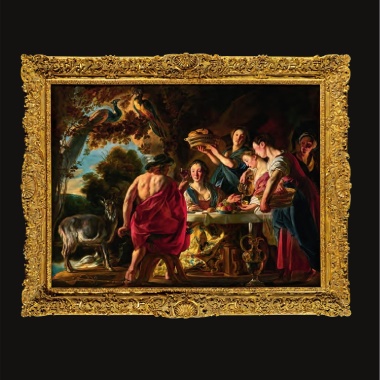
A NOTE ON THE FRAME


                                                                                                                                                                                        his is an archetypal example of the collector’s frame: a wide border of beautifully-composed
                                                                                                                                                                                        detail, refined, elegant, and sensitively carved, with a varied ground and a balance of matte and
                                                                                                                                                                                        burnished gilding, designed to show off a particularly precious painting by surrounding it in a soft

                                                                                                                                                                                        halo of shifting light and melting textures.
                                                                                                                                                                          T As Bruno Pons has pointed out of the 18th century, many frames in a collection would have rel-
                                                                                                                                                                           atively plain, economic settings, but the jewels in those collections would be highlighted by a major piece of
                                                                                                                                                                           sculpture, creating an eye-catching focus in the centre of a wall or over a chimneypiece. For example, Poussin’s

                                                                                                                                                                           Adoration of the golden calf and its pendant, The crossing of the Red Sea, were acquired in the late 17th century
                                                                                                                                                                           by the father of J-B le Ragois de Bretonvilliers, who, when he inherited the family hôtel together with its art
                                                                                                                                                                           collection, redecorated the interior of the former (c.1710), and had the two Poussins framed to match in
                                                                                                                                                                           spectacular Régence frames, which they still possess. In the same way, the original owner of this large and very
                                                                                                                                                                           handsome Jordaens painting would almost certainly have had it framed in a grand luxe French frame, since this
                                                                                                                                                                           would be both fashionable and expertly crafted; thus its appearance now may be a very accurate analogue of

                                                                                                                                                                           how it might originally have appeared.


                                                                                                                                                                           The frame is a Louis XIV pattern, dating from the last third of the 17th century, with a gently flowing ogee
                                                                                                                                                                           profile and projecting centres and corners. The surface is animated with a rhythmic dance of scrolling acanthus
                                                                                                                                                                           leaves and grooved strapwork on a cross-hatched ground, punctuated at the demi-centres by opposed C-scrolls

                                                                                                                                                                           and leaf buds, which - like the corner and centre ornaments - overflow their boundary into the sanded frieze
                                                                                                                                                                           below. The corners are decorated with tripartite acanthus leaves, leaf buds, and many-petalled daisies springing
                                                                                                                                                                           from roses-à-tiges; they end in projecting shells, and are infilled with diapering inscribed into the gesso layer.
                                                                                                                                                                           The centres have detailed scallop shells set in strapwork cartouches filled with more diapering, and scattered
                                                                                                                                                                           with tiny leaves, buds and berries. Beyond the sanded frieze, the sight edge has acanthus leaves and buds on a
                                                                                                                                                                           striated, hatched ground.


                                                                          48                                                                                                                                                    49

