


Page 62 - Jordaens
P. 62
t first acquaintance Jacob Jordaens appears to be the quintessentially Flemish painter of his                                                 he subject of our painting was among the favourite
                                     century, alive to native tradition in colour, design and choice of subject, the illustrator of                                                profane themes of the artist’s early career. On several
                                     Flemish life and of Flemish proverbs.  He lived only in Antwerp, and never travelled further                                         Toccasions he adapted Aesop,  Fables,  LXXIV, to his

                                     than Amsterdam.  Indeed, when he moved house, it was just from the Everdijstraat to the                                               purposes: the absurdity of the peasant who, having breathed on
                     A Hoogstraat, or in the Hoogstraat from one house to the next in order to join the two. He had                                                        his hands to warm them, then blows on his porridge to cool it,
                     only one master, Adam van Noort, who, like Jordaens never went to Italy.                                                                              excites the visiting satyr’s shocked protest. The moral is that
                                                                                                                                                                                                                                  2
                                                                                                                                                                           one should beware of people who ‘blow hot and cold’.  Loosely
                     However, unlike van Noort, Jordaens was not to be of merely provincial reputation. Within his lifetime the                                            translated, Aesop’s verses read: ‘Why, satyr, do you now shun

                     demand for his work extended far beyond the bound of Flanders: to Uppsala, to London, to Vienna, to Florence                                          the farmer so ungraciously?  Is it because you saw him blow on

                     and to Turin, as well as to Amsterdam and The Hague. Amongst his pupils, of whom the names of more                                                    his hands to warm them, and on his porridge to cool it?’ To
                     than a score are regis  tered, one came from Poland, another was recommended from Sweden. His fame was                                                which the satyr replies ‘I abhor this ambiguity of blowing hot
                                                                                                         1
                                                                                                                                                                                     3
                     spread abroad by sets of tapestries woven by the Brussels weavers from his cartoons,  and by impressions from                                         and cold.’  Jordaens’ earliest known treatment was painted on a
                     copperplates engraved after his designs in Antwerp, as well as by paintings. He illustrated stories from Aesop,                                       much smaller scale around 1616-17 (Glasgow, Sir John Stirling
                                                                                                                                                                                                               4
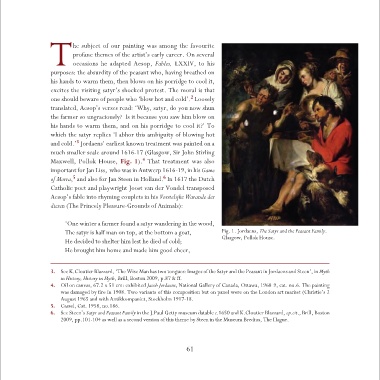
                     Homer, Ovid and Livy; as well as the homely saws of Jacob Cats. He depicted the moment in her banquet for                                             Maxwell, Pollok House, Fig. 1).  That treatment was also
                     Anthony when Cleopatra dissolves her pearl in wine, and he did so with a gusto outdone only by his relish for                                         important for Jan Liss,  who was in Antwerp 1616-19, in his Game
                                                                                                                                                                                                                       6
                                                                                                                                                                                   5
                     the moment in the Epiphany Feast when the Twelfth Night King raises his glass to drink. As a narrator he lacked                                       of Morra,  and also for Jan Steen in Holland.  In 1617 the Dutch
                     the more profound scholarly instincts of Rubens, and his brand of Christian Stoicism. But he moralised his tales                                      Catholic poet and playwright Joost van der Vondel transposed
                     generally without pedantry: the history of Alexander or of Ulysses or of Charlemagne, as well as the Acts of                                          Aesop’s fable into rhyming couplets in his Vorstelijke Warande der

                     the Apostles and the Parables of the New Testament. He made cheerful incidents in the life of the Holy Family                                         dieren (The Princely Pleasure-Grounds of Animals):
                     as vividly accessible as the incidents of his own household or of his neighbour’s. But his deep feelings for the
                     tragic scenes of the Passion - he was in this a true follower of Caravaggio - transmogrified ordinary types and                                            ‘One winter a farmer found a satyr wandering in the wood,
                     commonplace objects.                                                                                                                                       The satyr is half man on top, at the bottom a goat,           Fig. 1. Jordaens, The Satyr and the Peasant Family.
                                                                                                                                                                                He decided to shelter him lest he died of cold;               Glasgow, Pollok House.
                                                                                                                                                                                He brought him home and made him good cheer,
                                                                        a


                                                                                                                                                                           3.   See K.Cloutier Blazzard, ‘The Wise Man has two tongues: Images of the Satyr and the Peasant in Jordaens and Steen’, in Myth
                                                                                                                                                                              in History, History in Myth, Brill, Boston 2009, p.87 & ff.
                                                                                                                                                                           4.   Oil on canvas, 67.2 x 51 cm: exhibited Jacob Jordaens, National Gallery of Canada, Ottawa, 1968-9, cat. no.6. The painting
                                                                                                                                                                              was damaged by fire in 1908. Two variants of this composition but on panel were on the London art market (Christie’s 2
                                                                                                                                                                              August 1965 and with Antikkompaniet, Stockholm 1917-18.
                     1.   See the preceding entry regarding Hermes at Calypso’s Table on p.20.                                                                             5.   Cassel, Cat. 1958, no.186.
                     2.  See Laura Cruz, W. Th. M. Frijhoff, Myth in History, History in Myth, Society for Netherlandic History (U.S.). International                      6.   See Steen’s Satyr and Peasant Family in the J.Paul Getty museum datable c.1650 and K.Cloutier Blazzard, op.cit., Brill, Boston
                         Conference, 2009, Brill’s Studies in Intellectual History 182.                                                                                       2009, pp.101-104 as well as a second version of this theme by Steen in the Museum Bredius, The Hague.


                                                                          60                                                                                                                                                    61

