


Page 65 - Jordaens
P. 65
source at the left, with a subtly rich play
                                                                                        of chiaroscuro not only on the features and
                                                                                        gestures of the figures, human and pagan,

                                                                                        but also on the splendidly realized still-
                                                                                        life hung on the wall where the basket and
                                                                                        Italianate earthenware vessels are closely
                                                                                        observed. The play of light differs from that
                                                                                        in the well-known composition of the same

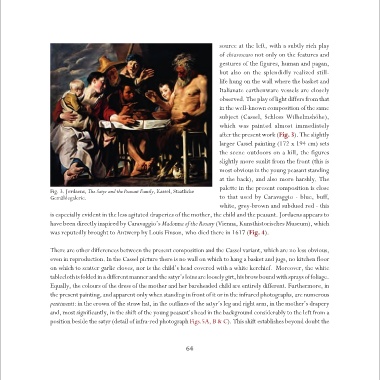
                                                                                        subject (Cassel, Schloss Wilhelmshöhe),
                                                                                        which was painted almost immediately
                                                                                        after the present work (Fig. 3). The slightly
                                                                                        larger Cassel painting (172 x 194 cm) sets
                                                                                        the scene outdoors on a hill, the figures
                                                                                        slightly more sunlit from the front (this is

                                                                                        most obvious in the young peasant standing
                                                                                        at the back), and also more harshly. The
                                                                                        palette in the present composition is close                                                                                               Fig. 5A. Jordaens, The Satyr and the Peasant Family. Schematic
                     Fig. 3. Jordaens, The Satyr and the Peasant Family, Kassel, Staatliche                                                                                                                                       of the pentiments.
                     Gemäldegalerie.                                                    to that used by Caravaggio - blue, buff,
                                                                                        white, grey-brown and subdued red - this
                     is especially evident in the less agitated draperies of the mother, the child and the peasant. Jordaens appears to
                     have been directly inspired by Caravaggio’s Madonna of the Rosary (Vienna, Kunsthistorisches Museum), which
                     was reputedly brought to Antwerp by Louis Finson, who died there in 1617 (Fig. 4).


                     There are other differences between the present composition and the Cassel variant, which are no less obvious,

                     even in reproduction. In the Cassel picture there is no wall on which to hang a basket and jugs, no kitchen floor
                     on which to scatter garlic cloves, nor is the child’s head covered with a white kerchief.  Moreover, the white
                     tablecloth is folded in a different manner and the satyr’s loins are loosely girt, his brow bound with sprays of foliage.
                     Equally, the colours of the dress of the mother and her bareheaded child are entirely different. Furthermore, in
                     the present painting, and apparent only when standing in front of it or in the infrared photographs, are numerous                                     Fig. 4. Michelangelo Merisi, called Caravaggio, Madonna of the   Fig. 5B. Jordaens,  pentiment   Fig. 5C. Jordaens, pentiment

                     pentimenti: in the crown of the straw hat, in the outlines of the satyr’s leg and right arm, in the mother’s drapery                                  Rosary. Vienna Kunsthistorisches Museum.               in the head of the boy adjacent   in the head of the standing
                     and, most significantly, in the shift of the young peasant’s head in the background considerably to the left from a                                                                                          to the satyr.                youth.
                     position beside the satyr (detail of infra-red photograph Figs.5A, B & C). This shift establishes beyond doubt the


                                                                          64                                                                                                                                                    65

