Page 64 - Jordaens
P. 64

When the man blew on his hands to warm them he took note,
                                                                                                                                                                                Asking him why the peasant replied, “I am warming my knuckles all stiff
                                                                                                                                                                                from the wintery cold;"

                                                                                                                                                                                When the peasant also blew on his hot food, laid out on a rough board,
                                                                                                                                                                                The satyr, rather confused, wondered at this,
                                                                                                                                                                                Apprehensive, he flew out of the door in fear of his life,
                                                                                                                                                                                Because he perceived the peasant could blow both hot and cold.
                                                                                                                                                                                For as the saying goes, ‘The Wise man always shows love and goodwill,

                                                                                                                                                                                Towards him that holds fire in one hand and water in the other,
                                                                                                                                                                                In order to avoid his evil sorcery’.


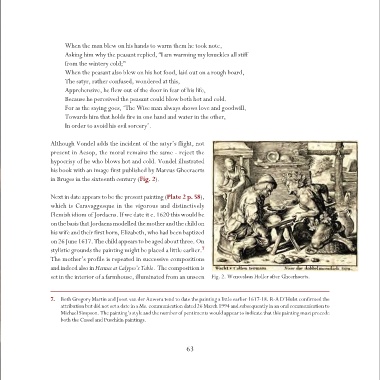
                                                                                                                                                                           Although Vondel adds the incident of the satyr’s flight, not
                                                                                                                                                                           present in Aesop, the moral remains the same - reject the
                                                                                                                                                                           hypocrisy of he who blows hot and cold. Vondel illustrated

                                                                                                                                                                           his book with an image first published by Marcus Gheeraerts
                                                                                                                                                                           in Bruges in the sixteenth century (Fig. 2).


                                                                                                                                                                           Next in date appears to be the present painting (Plate 2 p. 58),

                                                                                                                                                                           which is Caravaggesque in the vigorous and distinctively
                                                                                                                                                                           Flemish idiom of Jordaens. If we date it c. 1620 this would be
                                                                                                                                                                           on the basis that Jordaens modelled the mother and the child on
                                                                                                                                                                           his wife and their first born, Elizabeth, who had been baptized
                                                                                                                                                                           on 26 June 1617. The child appears to be aged about three. On
                                                                                                                                                                                                                                      7
                                                                                                                                                                           stylistic grounds the painting might be placed a little earlier.
                                                                                                                                                                           The mother’s profile is repeated in successive compositions
                                                                                                                                                                           and indeed also in Hermes at Calypso’s Table.  The composition is
                                                                                                                                                                           set in the interior of a farmhouse, illuminated from an unseen  Fig. 2. Wenceslaus Holler after Gheerhaerts.


                                                                                                                                                                           7.   Both Gregory Martin and Joost van der Auwera tend to date the painting a little earlier 1617-18. R-A D’Hulst confirmed the
                                                                                                                                                                              attribution but did not set a date in a Ms. communication dated 26 March 1994 and subsequently in an oral communication to
                                                                                                                                                                              Michael Simpson. The painting’s style and the number of pentiments would appear to indicate that this painting must precede
                                                                                                                                                                              both the Cassel and Puschkin paintings.


                                                                          62                                                                                                                                                    63


          Detail of Plate 2
   59   60   61   62   63   64   65   66   67   68   69