


Page 57 - Joseph Wright of Derby: Virgils's Tomb & The Grand Tour.
P. 57
and designers were profoundly influenced by what
this group had learned in Italy.

lll

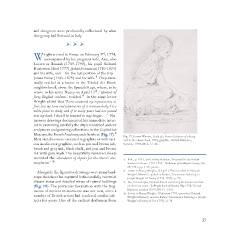
W right arrived in Rome on February 3rd, 1774,                Fig. 17. JOSEPH WRIGHT, Study of a Roman Sculpture of aYoung
       accompanied by his pregnant wife, Ann, also            Girl in the Sketch-Book, 1774, graphite. British Museum,
known as Hannah (1749-1790), his pupil Richard                London, 1939,0814.1.1-46.
Hurleston (died 1777), John Downman(1750-1824)
and his wife, and – for the last portion of the trip –        7. Ibid., p. 1023, and Lindsay Stainton, ‘Hayward’s List: British
James Paine (1745-1829) and his wife.7 They even-                Visitors to Rome, 1753-1775,’ TheVolume of theWalpole Society, No.
tually settled in a house in the Trinità dei Monti               49, 1983, pp. 3-36, passim.
neighborhood, above the Spanish Steps, where, as he
wrote to his sister Nancy on April 13th, ‘upwards of          8. Letter to Nancy Wright, 13 April 1774, recorded in ‘Hannah
forty English students’ resided.8 In the same letter             Wright’s Memoir,’ quoted in Barker, ‘Documents Relating to
Wright added that ‘Rome answered my expectations at              Joseph Wright ‘of Derby’(1734-1797),’ p. 79.
first, but my Love and admiration of it increase daily.Tis a
noble place to study and if so many years had not passed      9. See, for example, the sketchbook containing 46 leaves inscribed
over my head, I shou’d be tempted to stay longer….’ Nu-          on the front cover, ‘Jo:Wright Book of Sketches Feby 1774,’ British
merous drawings documented his immediate inter-                  Museum, London (1939,0814.1.1-46).
est in examining carefully the city’s renowned ancient
sculptures and painting collections in the Capitoline         10. Letter to Nancy Wright, 4 February 1774, quoted in ‘Hannah
Museum, the FrenchAcademy, and elsewhere (Fig. 17).9             Wright’s Memoir,’ cited in Barker, ‘Documents Relating to Joseph
Most sketches were executed in graphite or with vari-            Wright ‘of Derby’(1734-1797),’ p. 78.
ous media over graphite, such as pen and brown ink,
brush and grey ink, black chalk, and pen and brown
ink with grey wash. The beautifully rendered sheets
recorded the ‘abundance of objects for the Artist’s con-
templation.’10

  Alongside the figurative drawings were many land-
scape sketches that captured both carefully executed
distant vistas and detailed views of ruined buildings
(Fig. 18). The particular fascination with the frag-
ments of ancient monuments was not new, since a
number of British artists had rendered similar sub-
jects for years. One of the earliest draftsmen from

                                                              57

