


Page 58 - Joseph Wright of Derby: Virgils's Tomb & The Grand Tour.
P. 58
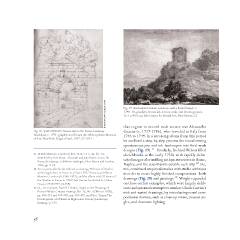
© METROPOLITAN MUSEUM OF ART                                       Fig. 19. ALEXANDER COZENS, Landscape with a RuinedTemple, c.
                                                                       1746–50, graphite, brown ink, brown wash, and brown ground,
                                                                       32.1 x 40.6 cm.Yale Center for British Art, New Haven, CT.

Fig. 18. JOSEPH WRIGHT, Roman Arch in the Italian Landscape            that region to record such scenes was Alexander
Sketchbook, c. 1774, graphite and brown ink. Metropolitan Museum
of Art, NewYork, Rogers Fund, 1957, 57.102.1.                          Cozens (c. 1717-1786), who traveled in Italy from

11. British Museum, London (1867,1012.1-51, esp. fol. 7r),             1746 to 1749. In a surviving album from this period
   described by Kim Sloan, Alexander and John Robert Cozens:The
   Poetry of Landscape, exhibition catalogue, New Haven and London,    he outlined a step-by-step process for transforming
   1986, pp. 9-14.
                                                                       spontaneous pen and ink landscapes into final wash
12. See in particular his sketchbook containing 78 leaves of ‘Studies  designs (Fig. 19).11 Similarly, Richard Wilson filled
   and Designs done in Rome in yeYear 1752,’Victoria and Albert
   Museum, London (E.3586-1922), and the album with 32 leaves of       sketchbooks in the early 1750s with rapidly delin-
   the ‘Studies in Rome in 1754,’Yale Center for British Art, New
   Haven, CT (B1977.14.359).                                           eated images of crumbling antique structures in Rome,
                                                                       Naples, and the countryside outside each city.12 He,
13. Cf., for example, David H. Solkin, ‘Light on the Drawings of
   Richard Wilson,’ Master Drawings,Vol. 16, No. 4 (Winter 1978),      too, combined empirical studies with studio additions
   pp. 404-414 and 467-478, esp. 404-407, and Flett, ‘Ruins:The
   Development of a Theme in Eighteenth-Century Landscape              in order to create highly-finished compositions - both
   Painting,’ p. 179.                                                  drawings (Fig. 20) and paintings.13 Wright expanded

                                                                       on these earlier examples, which were largely delib-

                                                                       erate and systematic attempts to emulate Claude Lorrain’s

                                                                       rich and varied drawings, by introducing novel com-

                                                                       positional devices, such as close-up views, unusual an-

                                                                       gles, and dramatic lighting.

58

