


Page 165 - The mystery of faith
P. 165
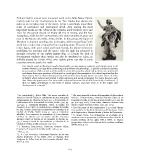
Perhaps Gijón’s second most renowned work is the Saint Simon Cyrene        Fig. 5
(1687) made for the Confraternity de las Tres Caídas that depicts the
saint as an everyday man of the street. It has a startlingly naturalistic
sense of movement and anatomical detail. Also among his most
important works are the Christ at the Column, made between 1671 and
1672 for the parish church of Alcalá del Rio in Utrera, and the four
Evangelists, made for the Confraternity of la Dulce Nombre de Jesús and
now in the Museo des Bellas Artes, Seville. In this group, the figure of
Matthew is depicted standing, lost in thought, whilst transcribing God’s
word into a codex that is supported by a standing putto. The pose of this
infant figure, with arms raised and heads bowed, the plump volumetric
modelling, the anatomy and the stance with the right leg advanced is
strongly evocative of our Infant Baptist (Fig. 5). Despite the lack of
documentary evidence these works can also be attributed to Gijon, as
skilfully argued by Gómez Piñol, who rightly points out that in some
cases the artwork speaks for itself:

One should avoid attributing artworks based solely on documentary evidence, and remain open to all
written references, not just those confirming only problems of authorship […] specific conclusions devalue
[our perception of] the artistic and the aesthetic nature [of artworks, which are] so often more substantial
and deeper than mere questions of historical or sociological documentation. It is often forgotten that the
documentary data is almost always partial, and has often been shaped by the corrective nature of other
[scholars] whose nature [and motive] is often unknown and purely contingent. For many, however, such
data claims the appearance of an inexorable reality and becomes a kind of de facto body of evidence [...]
[this is] highly problematic in the field of human sciences, and even more so in the origins and
development of artworks.7

1 See particularly J. RODA PEÑA, ‘Un nuevo aprendiz de          5 The most generally referenced biographies of this sculptor
Francisco Antonio Gijón’, in Laboratorio de arte: revista del   are by C. GARCÍA ROSELL, ‘Francisco Antonio Gijón’, in De
Departamento de Historia del Arte, no. 9, Secretariado de       Jerusalén a Sevilla. La Pasión de Jesús, Seville 2005, vol. III,
Publicaciones de la Universidad de Sevilla, Seville 1996, pp.   pp. 408–409; and J. RODA PEÑA, Francisco Antonio Ruiz
341–343; J. GONZÁLEZ MORENO, ‘Sobre la familia del              Gijón: escultor utrerano, Utrera 2003, pp. 27–33.
imaginero Ruiz Gijón’, in Boletín de las cofradías de Sevilla,
no. 494, Consejo General de Hermandades y Cofradías de la       6 The full name of the confraternity is La Reale Illustre
Ciudad de Sevilla, Seville 2000, p. 146; J. GONZÁLEZ            Hermandad y Cofradía de Nazarenos del Santísimo Cristo
MORENO, ‘Los contratos de aprendizaje de Juan Antonio           de la Expiración y Nuestra Madre y Señora del Patrocinio.
Cardoso de Quirós con el maestro escultor Francisco
Antonio Gijón’, in Boletín de las cofradías de Sevilla, no.     7 E. GÓMEZ PIÑOL, ‘Las atribuciones en el estudio de la
591, Consejo General de Hermandades y Cofradías de la           escultura: nuevas propuestas y reflexiones sobre obras de la
Ciudad de Sevilla, Seville 2008, pp. 503–505.                   escuela sevillana de los siglos XVI y XVII’, in Nuevas
                                                                perspectivas críticas sobre historia de la escultura sevillana,
2 J. BERNALES BALLESTEROS, Francisco Antonio Gijón,             Seville 2007, p. 17.
Diputación Provincial de Sevilla, Seville 1982, p. 39.

3 Ibid., p. 43.

4 J. A. Ceán Bermúdez, Diccionario histórico de los más
ilustres profesores de las Bellas Artes en España, Real
Academia de Bellas Artes de San Fernando, Madrid 1800,
vol. II, p. 199.

165

