


Page 227 - The mystery of faith
P. 227
Clerecía at Tormes. However, this work was not the first Jesuit
commission executed by the Toro workshop; Ducete also
carved two sculptures in the round of Saint Stanislaus Kostka
and Saint Louis of Gonzaga for the Jesuit school at Medina
del Campo in 1605. Later in 1620, the Toro workshop made
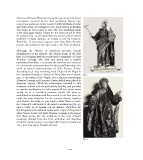
a life-sized Saint Francis Xavier for the Jesuit school at Villa
de Campos (Fig. 3), an image that was paired with an earlier
sculpture of Saint Ignatius of Loyola carved by Gregorio
Fernández. In any case, it appears more than likely that the
present two sculptures were also made in the Toro workshop.

Although the absence of attributes prevents certain                 Fig. 3
identification of the subjects, the evident youth of the first
bust is in keeping with the traditional iconography of Saint
Aloysius Gonzaga, who died very young and is usually
represented beardless. Conversely, the maturity and inclusion
of a moustache and goatee beard in the second bust relate this
work to typical representations of Saint Francis Xavier.
According to an 1835 inventory, in the Chapel of the Virgin in
the Carmelite Descalzes Convent in Toro, there were located,
next to the image of the Virgin, two sculptures representing
Aloysius Gonzaga and Francisco Xavier, which were placed in
shuttered alcoves. While the information included in this
inventory is brief, and not particularly detailed, and provides
no specific explanation for why images of two Jesuit saints
would be in a Carmelite convent, Rueda did have an
established relationship with this convent. In the first place, he
made the main altarpiece for the convent church, together
with Ducete. Secondly, he also made a Saint Teresa to mark
the Convent’s celebration of the saint’s canonization (Fig. 4);
and a Cristo de la Agonía con las Marías. Therefore, we
should question the assumed Salamancan origin of the present
Saint Francis Xavier and Saint Aloysius Gonzaga and propose
that these works, like the sculptures in the 1853 convent
inventory, derived from the Toro workshop and therefore
should be dated between 1620 (just after Ducete’s death) and
1625 (not long before Rueda’s demise).

                         Fig. 4

227

