


Page 18 - Jacobello del Fiore - His Oeuvre and a Sumptuous Crucifixion
P. 18
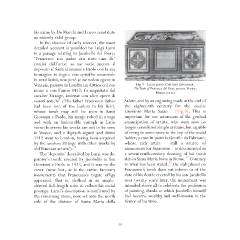
his name by De Marchi and Lucco constitute                  Fig. 9 - EIGHTEENTH CENTURY ENGRAVER:
an entirely valid group.                                   The Tomb of Francesco del Fiore, painter, Venice,

   In the absence of early sources, the most                               Museo correr
detailed account is provided by Luigi Lanzi
in a passage relating to Jacobello del Fiore:       Salute, and by an engraving made at the end of
‘Francesco suo padre era stato uno de’              the eighteenth century for the erudito
corifei dell’arte: se ne vede ancora il             Giovanni Maria Sasso - ( Fig. 9). This is
deposito a’ Santi Giovanni e Paolo con la sua       important for our awareness of the gradual
immagine in toga e con epitaffio onorevole          emancipation of artists, who were now no
in versi latini; non però se ne vedon opere in      longer considered simple artisans, but capable
Venezia, passato in Londra un dittico col suo       of rising in some cases to the top of the social
nome e con l’anno 1412: fu acquistato dal           ladder; a case in point is Gentile da Fabriano,
cavalier Strange, insieme con altre opere di        whose rich attire – still a source of
veneti antichi’ (‘His father Francesco father       amazement for Sansovino – is documented in
had been one of the leaders in his field,           a seventeenth-century drawing of his tomb
whose tomb may still be seen in Santi               slab in Santa Maria Nova in Rome.19 Contrary
Giovanni e Paolo, his image robed in a toga         to what has been stated,20 the slab placed on
and with an honourable epitaph in Latin             Francesco’s tomb does not inform us of the
verse; however his works are not to be seen         date of his death: erected by his son Jacobello
in Venice, and a diptych signed and dated           over twenty years later, the monument was
1412 went to London, having been acquired           intended above all to celebrate the profession
by the cavaliere Strange with other works by        of painting, thanks to which Jacobello himself
old Venetian artists’).18                           had become wealthy and well-known in the
                                                    Venice of his time.
   The ‘deposito’ described by Lanzi was the
painter’s tomb, erected by Jacobello in San
Giovanni e Paolo in 1433, and it was on the
cover (now lost, as is the entire funerary
monument) that Francesco’s togate effigy
appeared, that is, clothed in an ample-
sleeved full-length robe to reflect his social
prestige. Lanzi’s description is confirmed by
the remaining stone, now set into the north
side of the cloister of Santa Maria della

                                                19

