


Page 16 - Jacobello del Fiore - His Oeuvre and a Sumptuous Crucifixion
P. 16
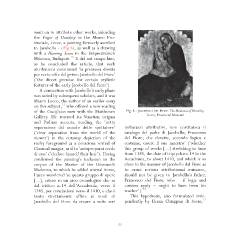
went on to attribute other works, inlcuding           Fig. 8 - JACOBELLO DEL FIORE: The Madonna of Humility,
the Virgin of Humility in the Museo Pro-                             Lecce, Provincial Museum
vinciale, Lecce, a painting formerly ascribed
to Jacobello - ( Fig. 8), as well as a drawing       imbarazzi attributivi, non costituisca il
with a Hunting Scene in the Szépmüvészeti            catalogo del padre di Jacobello, Francesco
Múzeum, Budapest.10 It did not escape him,           del Fiore; che dovette, secondo logica e
as he concluded the article, that such               costume, essere il suo maestro’ (‘whether
attributions constituted ‘la premessa diretta        this group of works […] stretching in time
per certe cifre del primo Jacobello del Fiore’       from 1385, the date of triptych no.14 in the
(‘the direct premise for certain stylistic           Accademia, to about 1410, and which is so
features of the early Jacobello del Fiore’).         close to the manner of Jacobello dal Fiore as
                                                     to cause serious attributional nuisance,
   A connection with Jacobello’s early phase         should not be given to Jacobello’s father,
was noted by subsequent scholars, and it was         Francesco del Fiore, who – if logic and
Mauro Lucco, the author of an earlier essay          custom apply – ought to have been his
on this subject,11 who offered a new reading         teacher’).12
of the Crucifixion now with the Matthiesen
Gallery. He restated its Venetian origins               This hypothesis, also formulated inde-
and Paduan accents, reading the ‘netta               pendently by Ileana Chiappini di Sorio,13
separazione dal mondo dello spettatore’
(‘clear separation from the world of the
viewer’) in the cutaway depiction of the
rocky foreground as a conscious revival of
Classical images, as if to ‘autoproporsi erede
di esse’ (‘declare himself their heir’). Having
confirmed the painting’s inclusion in the
corpus of the Master of the Giovanelli
Madonna, to which he added several items,
Lucco wondered ‘se questo gruppo di opere
[…], esteso su un arco cronologico che va
dal trittico n. 14 dell’Accademia, verso il
1385, per concludersi verso il 1410, e che è
tanto strettamente affine ai modi di
Jacobello del Fiore da creare a volte seri

                                                 17

