


Page 20 - Jacobello del Fiore - His Oeuvre and a Sumptuous Crucifixion
P. 20
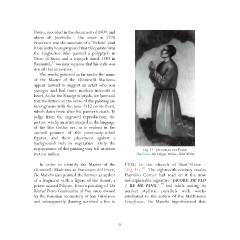
Pietro, recorded in the document of 1409, and                        Fig. 11 - JACOBELLO DEL FIORE:
above all Jacobello. But since in 1376                         The Blessed Fra Filippo, Venice, Sant’Alvise
Francesco was the associate of a ‘Vielmo’ (and
it has justly been proposed that this painter was      1705) in the church of Sant’Alvise -
the Guglielmo who painted a polyptych in               ( Fig. 11).28 The eighteenth-century erudito
Piove di Sacco and a triptych dated 1383 in            Flaminio Corner had read on it the now
Recanati),27 we may suppose that his style was         indecipherable signature ‘JACOBE. DE FLO
not all that innovative.                               / RE ME PINX.’;29 but while noting its
                                                       perfect stylistic parallels with works
   The works gathered so far under the name            attributed to the author of the Matthiesen
of the Master of the Giovanelli Madonna                Crucifixion, De Marchi hypothesized that
appear instead to suggest an artist who was
younger and had more modern interests at
heart.As for the Strange triptych, we have said
that the letters on the verso of the painting are
incongruous with the year 1412 on its front,
which dates from after the painter’s death. To
judge from the engraved reproduction, the
picture was by an artist steeped in the language
of the late Gothic era, as is evident in the
curved posture of the preciously-robed
figures, and their placement against a
background rich in vegetation. Only the
reappearance of this painting may tell us about
its true author.

   In order to identify the Master of the
Giovanelli Madonna as Francesco del Fiore,
De Marchi also posited the former as author
of a fragment with a figure of the donor, a
priest named Filippo, from a painting of The
Blessed Pietro Gambacorta of Pisa once owned
by the Venetian monastery of San Girolamo
and subsequently (having survived a fire in

                                                   21

