


Page 16 - Luca Giordano - Liberation of St Peter
P. 16
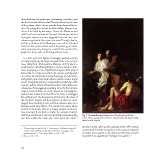
their shadows, the innkeeper welcoming travellers, and                  Fig. 2. GIOVANNI BATTISTA CARACCIOLO, The Liberation of St Peter,
the dead carried off to burial.The mood is set by the bars              1615. Oil on canvas, 210 x 207 cm. Church of the Pio Monte della
of the prison, where, in an episode from classical litera-              Misericordia, Naples.
ture, the young Pero breast feeds her father Cimon, con-
demned to death by starvation. Above the Madonna and                    Nicolas Cochin, who saw the painting in the 18th century,
child look tenderly down at the world below, surrounded                 commented‘le Christ n’est point en l’air,et passe en marchant
by angels, whose embrace suggests fraternal love, and                   au travers des ses gardes; ce qui donne une idée basse et le fait
whose wings beat at the prison windows.Through charity,                 rassembler à un coupable qui s’échappe de ses gardes’.4
and the protection of the Madonna, man will be liberated
from the dark prison of this world; the painting, so insist-
ently contemporary, brings to vivid life the world of the
gospel for the people of the Neapolitan streets.

  In a later period in Naples Caravaggio painted a group
of original gallery paintings, amongst them a Denial of St
Peter, (NewYork, Metropolitan Museum of Art) where a
small number of half length figures seem isolated in dark-
ness, conveying a sense of guilt and despair, of the pity of
human life. He strips narrative to its essence, and depends
on a clear and intensely moving language of expression
and gesture, and a few bleak colours which create a tragic
mood. Neapolitan painters responded immediately to this
new art, and the church of Sant’Anna dei Lombardi became
a showcase of Caravaggesque painting. Here, for the Cortone
chapel, Carlo Sellitto, an early convert to Caravaggism,
painted two scenes from the life of St Peter. Caravaggio
himself painted The Resurrection of Christ for the altar of
the Fenaroli chapel, and descriptions of this lost work
suggest how startling it was, and how viewers were torn
between awed admiration of its novità, and unease about
its lack of decorum. Christ no longer ascends in miracu-
lous triumph from dark to light; he remains fearful,
suffering, earthbound, and rises painfully and awkwardly,
one foot within the tomb, the other upon the earth.3

3. The painting is described by L. Scaramuccia, Le finezze de’pennelli
   italiani, Pavia 1674, p.75. See also M.Marini, Caravaggio:‘pictor
   praestantissimus’, 3rd ed., Rome 2001, p. 582, P-26.

4. Ibid., p. 582, P-26.

14

