


Page 20 - Luca Giordano - Liberation of St Peter
P. 20
later the Eletti, or governors of the city, decided to have
painted, above each of the city gates, frescoes of the Im-
maculate Conception with the guardian saints of the city.
In November, shortly before the official end of the
plague, Mattia Preti, who had been in Naples since 1653,
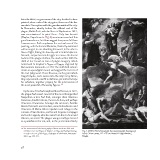
was commissioned to paint them. Only two bozzetti
(Naples, Capodimonte. Fig. 5) survive as records of this
grandiose scheme, but these suggest how powerful these
frescoes were. Both emphasise the vertical axis of the
painting, with the hieratic Madonna, flanked by saints and
with an angel, in one sheathing his sword, in the other a
blaze of light, linking the heavenly and terrestrial spheres.
Beneath, corpse bearers struggle to remove the heroic
bodies of the plague victims, the dead mother with the
child at her breast an icon of plague imagery, which
looks back to Raphael’s Plague at Phyrgia, engraved by
Marcantonio Raimondo c.1520. The cold dark colours
create an apocalyptic mood, and suggest the terrors of
the Last Judgement.These frescoes, on the gates which
ringed Naples, were woven into the city’s very fabric;
they represented a world in darkness, yet united in hope
for salvation, together praying for the intercession of
the most powerful of heavenly figures.15

  By the time Preti had completed these frescoes, in 1659,
the plague had ceased. Several of the most distinguished
Neapolitan artists had died, amongst them Massimo
Stanzione,Aniello Falcone, Pacecco de Rosa, and perhaps
Francesco Fracanzano. Amongst the survivors, besides
Mattia Preti and Luca Giordano, were AndreaVaccaro and
Francesco di Maria. Micco Spadaro took refuge in the
convent of San Martino, and he and Scipione Compagni
and Carlo Coppola, who also came from the circle around
Falcone, survived.The plague was generally perceived
as a punishment for sin, and, in the years immediately

15. For an account of the iconography of these works see ibid. and        Fig. 5. MATTEO PRETI, Bozzetto for the votive frescoes for the plague of
   J.Clifton, ‘Art and Plague at Naples’, in Hope and Healing: Painting   1656. Oil on canvas, 127 x 75 cm. Museo di Capodimonte,
   in Italy in the time of the Plague, catalogue of exhibition,Worcester  Naples.
   2005, pp. 490-497.

18

