


Page 24 - Luca Giordano - Liberation of St Peter
P. 24
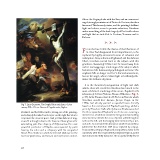
Above the Virgin pleads with her Son, and an evanescent
                                                                 angel, strongly reminiscent of Pietro da Cortona, sheathes
                                                                 his sword.This heavenly vision, and the painting’s brilliant
                                                                 light and colour, seem to promise salvation; Giordano
                                                                 unites something of the dark tragedy of Preti with colour
                                                                 and light that are indebted to Cortona, Veronese and to
                                                                 Rubens.

                                                                                  lll

                                                                 F rom the late 1640s the theme of the liberation of
                                                                     St Peter had disappeared from Neapolitan art, to be
                                                                 replaced by highly emotional scenes of salvation and
                                                                 redemption. Now, as the mood lightened, and the darkness
                                                                 lifted, Giordano turned back to the subject with this
                                                                 grandiose Liberation of St Peter. Here he moved away from
                                                                 earlier Caravaggesque renderings of the subject which
                                                                 had stressed the human and psychological narrative.The
                                                                 emphasis falls no longer on Peter’s fear and amazement,
                                                                 but on the angel, whose radiant light so brilliantly illu-
                                                                 mines the darkness of prison.

Fig. 7. LUCA GIORDANO, The Crucified Christ with Saints. Oil on    It is the theatrical juxtaposition of light and dark
canvas, 400 x 315 cm. Museo di Capodimonte, Naples.              which, above all, reveal that Giordano has turned to the
                                                                 most celebrated rendering of the scene, Raphael’s The
idealised, and the fallen timber jutting out of the painting,    Liberation of St Peter (Vatican, Stanza d’Eliodoro. Fig. 2,
and a sharply foreshortened corpse on the right threaten to      p.38). In the Roman church of S.Pietro inVincoli, which
erupt into the viewer’s space. And yet this darkened, trag-      Giordano would have known, Jacopo Coppi, in the
ic world is brought close to the heavens. Above gleams the       1570s, had already painted an apsidal fresco directly
astonishing pale blue drapery of St Januarius, the most          based on the central part of Raphael’s painting, whilst a
powerful protector of Naples, accompanied by putti               print by Theodore Galle after Johannes Stradanus united
bearing his mitre and a reliquary with his congealed             the three episodes of Raphael’s work into one, weaving a
blood. The clouds on which he sits cast shadows on the           dense frieze of soldiers across the foreground and adding
livid corpses below, and heaven and earth seem united.           some narrative details, the view of prison walls through an
                                                                 arch on the left, and the hanging lantern framed by a sec-
                                                                 ond arch. In contrast is the altarpiece which Domenichino
                                                                 painted for the church in 1604 (now replaced by a copy).
                                                                 Domenichino stripped Raphael’s composition down to its
                                                                 essentials, with four impressively sculptural figures, poses
                                                                 and colours carefully balanced. His is a powerfully direct

22

