


Page 39 - Vision & Ecstasy - Giovanni Benedetto Castiglione's St. Francis.
P. 39
With Bernardo Strozzi, the first Genoese artist to respond                                                              © PHILBROOK MUSEUM OF ART
       to the colour and brushwork of Rubens and Procaccini,
there was a particularly rich outpouring of Franciscan subjects.
Strozzi was himself a Capuchin friar, and opened his career with
‘small paintings of St Francis, or St Clare, or other saints of his
order’.18 Strozzi was to have a difficult relationship with the
Capuchins, and finally freed himself from them; Raffaelle Soprani,
whose vivid life of the painter is embellished with novellistic
details, describes him as at one stage imprisoned by his order, and,
‘sparing in his food, assiduous in prayer, humble, patient,
mortified. In all, a true portrait of sanctity’.19

   Strozzi painted St Francis throughout his life, and he showed
him in many ways; meditating on death, with the skull, rosary and
cross; adoring the Cross (Fig.7); displaying the stigmata, an open
book before him; holding aloft a processional cross, in a
composition which calls to mind Christ carrying the Cross.These
are devotional works, painted for use in the convent, or for private
worship, and evoke the aura of the cell. In a late version, the St
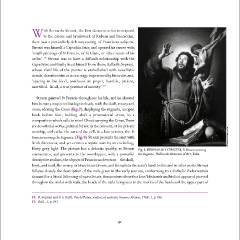
Francis receiving the Stigmata, (Fig. 8) Strozzi presents the saint with
fresh directness, and yet creates a mystic aura by an encircling,
bluey grey light. The picture has a didactic quality, as Strozzi Fig. 8. BERNARDO STROZZI, St Francis receiving
enumerates, and presents to the worshipper, with a powerful the Stigmata, Philbrook Museum of Art,Tulsa
descriptive realism, the objects of Franciscan devotion – the skull,
book, and cord, the rosary, or Franciscan Crown, and the nails in the saint’s hand. In this and in other works Strozzi
follows closely the description of the nails given in the early sources, conforming to a Catholic Reformation
demand for a literal following of sacred texts; Bonaventure describes how‘His hands and his feet appeared pierced
through in the midst with nails, the heads of the nails being seen in the insides of the hands and the upper part of

18. R.Soprani and C.G.Ratti, Vite de’Pittori, scultori, ed architetti Genovesi¸Genoa, 1768, 1, p.186.
19. Ibid., 1, p.193.

                                                  41

