


Page 41 - Vision & Ecstasy - Giovanni Benedetto Castiglione's St. Francis.
P. 41
of Pietro da Cortona and Bernini. Castiglione’s St Francis in Ecstasy
has something of the grandeur and emotional intensity of Roman
art, and yet it is rooted in the older tradition of Bernardo Strozzi,
enriched by a renewed response to the spiritual intensity of the
religious art of van Dyck. It stands between the old and the new,
between the immediacy of Strozzi, and the mystic and visionary
works of both Genoese and Lombard artists in the later years of
the century.

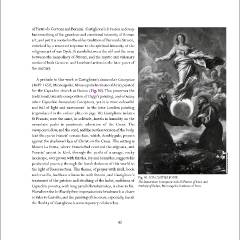
A prelude to this work is Castiglione’s Immaculate Conception

(1649-1650; Minneapolis, Minneapolis Institute of Arts) painted

for the Capuchin church at Osimo (Fig.10).This preserves the

traditional, hieratic composition of Paggi’s painting, and of many

other Capuchin Immaculate Conceptions, yet it is more colourful

and full of light and movement. In the later London painting

(reproduced in the colour plate on page 30) Castiglione isolates

St Francis; now the saint, in solitude, kneels in humility on the

mountain peaks in passionate adoration of the Cross. The

viewpoint is low, and the cord, and the restless torsion of the body,

lead the eye to Francis’ ecstatic face, which, deathly pale, presses

against the shadowed face of Christ on the Cross. The setting is

Mount La Verna, where Francis had received the stigmata, and

Francis’ ascent to God, through the perils of a savage, rocky                                                                    © MINNEAPOLIS INSTITUTE OF ART

landscape, overgrown with thistles, ivy and brambles, suggests his

penitential journey through the harsh darkness of this world to

the light of Resurrection. The theme, of prayer with skull, book

and crucifix, had been a favourite with Strozzi, and Castiglione’s      Fig. 10. G.B.CASTIGLIONE
treatment of the patches and stitching of the habit, emblems of         The Immaculate Conception with SS Francis of Assisi and

Capuchin poverty, with long parallel brushstrokes, is close to his. Anthony of Padua, Minneapolis Institute of Arts

Elsewhere the brilliantly free impressionistic brushwork is closer

toValerio Castello, and the painting of the cross, especially, has all

the fluidity of Castiglione’s contemporary oil sketches.

43

