


Page 35 - Vision & Ecstasy - Giovanni Benedetto Castiglione's St. Francis.
P. 35
and he lost all bodily sense’.8 Annibale’s small print presents the
saint to the viewer to inspire emulation, and in a slightly later
painting, St Francis showing the Cross this purpose is yet clearer; St
Francis, brought close to the frontal plane, confronts the viewer
directly, pointing, with the eloquent gesture of a preacher, to the
harsh landscape of retreat, inviting him to emulate his own
imitation of Christ. (Fig. 4)9

                   678

With Caravaggio and his many followers St Francis is
       transformed by a powerfully direct naturalism and
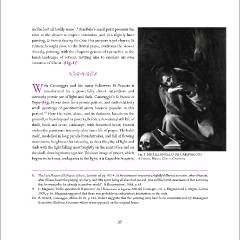
intensely poetic use of light and dark. Caravaggio’s St Francis in
Prayer (Fig. 5) was done for a private patron, and such relatively
small paintings of pentitential saints became popular in this
period.10 Here the saint, alone, and in darkness, kneels on the
ground, in humility and in poverty, before a devotional still life of
skull, book and cross. Unkempt, with furrowed brow, Francis
evokes the passionate intensity of an inner life of prayer.The habit
itself, modelled in long parallel brushstrokes, and full of flowing
movement, heightens this intensity, as does the play of light and
dark with the light falling most brightly on the saint’s face and on
the skull, drawing them together.This is an image of prayer, which Fig. 5. MICHELANGELO DA CARAVAGGIO
begins in darkness, and aspires to the light; it is Capuchin in spirit, St Francis, Museo Civico, Cremona

8. The Little Flowers of St Francis of Assisi, London nd pp.183-4. St Bonaventure recounts a slightly different moment, when Francis,
     after illness, hears the playing of a harp, and‘His spirit being all absorbed in God, was so filled with sweetness of that harmony
     that he seemed to be already in another world’. St Bonaventure, 1868, p.65.

9. L. Magnani,‘Nello specchio di Francesco’, in I Francescani in Liguria,Atti del Convegno, ed. L.Magnani and L.Stagno, Genoa
     2009, p.36. Magnani suggested that there was probably an exhortatory inscription on the rock.

10. R.Vodret, Caravaggio, Milan 2010, p.144. Vodret suggests that the painting may have been commissioned by Monsignor
     Benedetto Ala from Cremona whose arms appeared on the original frame.

                                                  37

