


Page 51 - Vision & Ecstasy - Giovanni Benedetto Castiglione's St. Francis.
P. 51
extraordinary reconciliation of Castiglione’s established manner
with the new kind of subject and scale. The balance between
venerable and up-to-date, indigenous and foreign, idealised and
naturalistic seems practically programmatic, but with the
calculation and the intellectual effort largely hidden, the painting
attains symphonic grandeur.

Castiglione’s successive public work, around 1647, was the

canvas of Saint James Defeating the Moors for the Oratorio di San

Giacomo della Marina (Fig. 9), the meeting place of the

confraternity of the Order of Saint James of Compostella.14 The

central figure of Saint James foreshortened on horseback and

bearing the Order’s emblem of a red cruciform sword on his

breastplate has long been recognized as a quotation of Rubens’s

famous equestrian portrait of Giovan Carlo Doria, a leading

earlier member of the Order. Other sources in Rubens, possibly

known through engravings, have been proposed for some of the

dramatic postures in the painting like the falling soldier in the

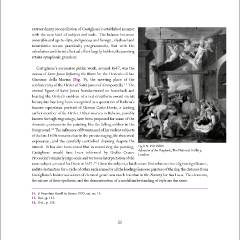
foreground.15 The influence of Poussin and of his violent subjects

of the late 1630s remains clear in the precise staging, the rhetorical

expression, and the carefully controlled drawing despite the

tumult. It has also been noted that in conceiving the painting, Fig.8 N. POUSSIN
                                                                        Adoration of the Shepherds,The National Gallery,
Castiglione  would have been informed by Giulio Cesare                  London.

Procaccini’s similarly large-scale and tortuous interpretation of the

same subject, created for Doria in 1621.16 Given the subject, a battle scene first whatever its religious significance,

and its destination for a cycle of other such scenes by all the leading Genoese painters of the day, the distance from

Castiglione’s boisterous scenes of elevated genre was much less than in the Nativity for San Luca. The elements,

the nature of their synthesis, and the demonstration of a modal understanding of style are the same.

14. F. Franchini Guelfi in Genoa 1990, cat. no. 15.
15. Ibid., p. 123.
16. Ibid., p. 126.

                                                     53

