


Page 54 - Vision & Ecstasy - Giovanni Benedetto Castiglione's St. Francis.
P. 54
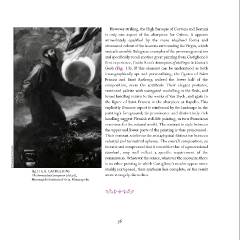
© MINNEAPOLIS INSTITUTE OF ARTS                                                 However striking, the High Baroque of Cortona and Bernini
                                                                             is only one aspect of the altarpiece for Osimo. It appears
                                 Fig.11 G.B. CASTIGLIONE                     immediately qualified by the more idealised forms and
                                 The ImmaculateConception (detail),          attenuated colour of the heavens surrounding theVirgin, which
                                 Minneapolis Instituteof Arts, Minneapolis.  instead resemble Bolognese examples of the previous generation
                                                                             and specifically recall another great painting from Castiglione’s
                                                                             first experience, Guido Reni’s Assumption of theVirgin in Genoa’s
                                                                             Gesù (Fig. 13). If this element can be understood as both
                                                                             iconographically apt and personalising, the figures of Saint
                                                                             Francis and Saint Anthony, indeed the lower half of the
                                                                             composition, seem the antithesis. Their elegant postures,
                                                                             restricted palette with variegated modelling in the flesh, and
                                                                             broad handling return to the works of Van Dyck, and again to
                                                                             the figure of Saint Francis in the altarpiece at Rapallo. This
                                                                             explicitly Genoese aspect is reinforced by the landscape in the
                                                                             painting’s foreground; its prominence and distinctively rich
                                                                             handling suggest Flemish still-life painting, in turn Franciscan
                                                                             reverence for the natural world. The contrast in style between
                                                                             the upper and lower parts of the painting is thus pronounced.
                                                                             Their contrast reinforces the metaphysical distinction between
                                                                             celestial and terrestrial spheres. The overall composition, so
                                                                             hieratic and compressed that it resembles that of a processional
                                                                             standard, may well reflect a specific requirement of the
                                                                             commission. Whatever the senses, whatever the accounts, there
                                                                             is no other painting in which Castiglione’s modes appear more
                                                                             starkly juxtaposed, their synthesis less complete, or the result
                                                                             more strangely discordant.

                                                                             678

                                                                             56

