


Page 59 - Vision & Ecstasy - Giovanni Benedetto Castiglione's St. Francis.
P. 59
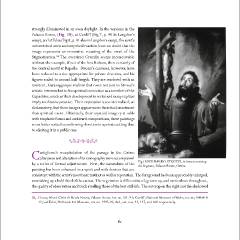
strongly illuminated in an even daylight. In the versions in the
Palazzo Rosso, (Fig. 18), at Cardiff (Fig.7, p. 40 in Langdon’s
essay), and atTulsa (Fig.8, p. 41 also in Langdon’s essay), the saint’s
outstretched arms and surprised reaction leave no doubt that the
image represents an innovative recasting of the event of the
Stigmatisation.26 The oversized Crucifix seems inconceivable
without the example, if not of the lost Rubens, then certainly of
the central motif at Rapallo. Strozzi’s canvases, however, have
been reduced to a size appropriate for private devotion, and his
figures scaled to around half-length. They are rendered with an
insistent, Caravaggesque realism that owes not just to Strozzi’s
artistic interests but to his spiritual conviction as a member of the
Capuchins, much as their development in series and many replicas
imply meditative practice. Their expression is so externalised, so
declamatory, that these images appear more theatrical enactment
than spiritual event. Ultimately, their mystical imagery at odds
with emphatic forms and awkward compositions, these paintings
seem better suited to confirming devotion in a private setting than
to eliciting it in a public one.

678

Castiglione’s recapitulation of the passage in the Osimo                 Fig.18 BERNARDO STROZZI, St Francis receiving
     altarpiece and alteration of its iconography were accompanied       the Stigmata, Palazzo Rosso, Genoa.
by a series of formal adjustments. First, the naturalism of the

painting has been enhanced in a spirit and with devices that are

consistent with the artist’s most basic instinct as well as reputation. The foreground has been appreciably enlarged,

now taking up a bold third of the canvas. The vegetation is differentiated, grown up, and meticulous throughout,

the quality of observation and touch rivalling those of the best still-life. The outcrop on the right and the shadowed

26. Genoa, Musei Civici di Strada Nuova, Palazzo Rosso, inv. no. P.R. 91; Cardiff, National Museum of Wales, inv. no. NMW A
     12; andTulsa, Philbrook Art Museum, inv. no. 1995.10; ibid., cat. nos. 23, 137, and 160 respectively.

     61

