


Page 63 - Vision & Ecstasy - Giovanni Benedetto Castiglione's St. Francis.
P. 63
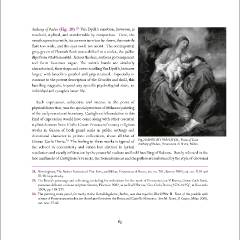
Anthony of Padua (Fig. 20).28 Van Dyck’s emotion, however, is
resolved, stylised, and comfortable by comparison. Here, the
mouth opens too wide, its corners turn too far down, the nostrils
flare too wide, and the eyes swell too moist. The contrapuntal
grey-green of Flemish flesh tones shifted to a violet, the pallor
slips from vital to morbid. Across the face, surfaces go transparent
and form becomes vague. The saint’s hands are similarly
characterised, their shape and curve recallingVan Dyck’s, but now
larger, with knuckles gnarled and grip strained. Especially in
contrast to the potent description of the Crucifix and skull, this
handling suggests, beyond any specific psychological state, an
individual and complex inner life.

Such expression, subjective and intense to the point of

physical distortion, was the special province of Milanese painting

of the early seventeenth century. Castiglione’s foundation in this

kind of expression would have come along with other essential

stylistic lessons from Giulio Cesare Procaccini’s many religious

works in Genoa of both grand scale in public settings and

devotional character in private collections, above all that of        Fig.20 ANTONYVAN DYCK, Vision of Saint
                                                                      Anthony of Padua, Pinacoteca di Brera, Milan.
Giovan Carlo Doria.29 The feeling in these works is typical of

the school in eccentricity and strain but distinct in lyrical

resolution and steady infiltration by the powerful realism and bold handling of Rubens. Barely relieved in the

face and hands of Castiglione’s Francis, the tremulousness and the pathos are informed by the style of Giovanni

28. Birmingham,The Barber Institute of Fine Arts, and Milan, Pinacoteca di Brera, inv. no. 701; Barnes 2004, cat. no. II.10 and
     III.38 respectively.

29. On Doria’s patronage and collecting, including his enthusiasm for the work of Procaccini, see V. Farina, Giovan Carlo Doria,
     promotore delle arti a Genova nel primo Seicento, Florence 2002, as well asV. Farina,‘Gio. Carlo Doria (1576-1625)’, in Boccardo
     2004, pp. 188-275.

30. The painting main panel, formerly in the Gemäldegalerie, Berlin, was destroyed in World War II. Four of the predelle with
     scenes of Franciscan miracles are distributed between the Brera and Castello Sforzesco. See M. Rosci, Il Cerano, Milan 2000,
     cat. nos. 37-42.

65

